

Good Carder
Professional
- Messages
- 916
- Reaction score
- 717
- Points
- 113
SS7 Vulnerabilities in 2026 – An Exhaustive Technical, Historical, and Defensive Analysis of the Legacy Signaling Protocol’s Persistent Flaws, 2025 Bypass Techniques, Real-World Exploitation Patterns, Global Interworking Risks, Multi-Protocol Defenses, and the Long Road to Deprecation
Signaling System No. 7 (SS7), a protocol suite first standardized in the late 1970s and early 1980s by the International Telecommunication Union (ITU-T), remains a foundational yet critically vulnerable component of global telecommunications infrastructure well into 2026. Originally designed for a closed, trusted ecosystem of fixed-line and early mobile operators to handle call setup, routing, SMS delivery, roaming, and subscriber management, SS7 operates without native authentication, encryption, or robust authorization. This architectural trust model — coupled with mandatory interworking for international roaming, 2G/3G fallback, and hybrid 4G/5G environments — continues to expose networks to sophisticated attacks including location tracking, SMS interception, call redirection, subscriber data theft, denial-of-service (DoS), and fraud. Despite widespread deployment of signaling firewalls since the mid-2010s, new bypass techniques (notably TCAP encoding manipulations documented in mid-2025), uneven global adoption of mitigations, and persistent legacy interconnects keep SS7 a live threat surface.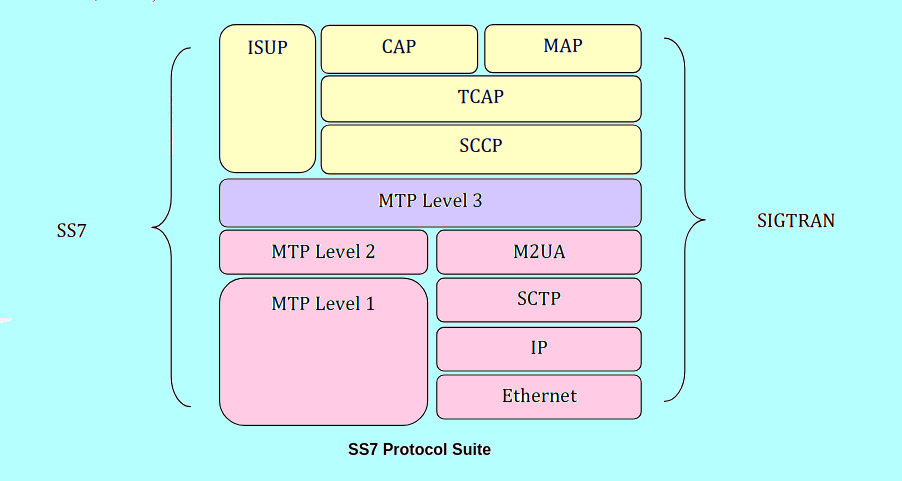
1. SS7 in 2026: Current Status, Usage Statistics, and Why It Persists
As of April 2026, SS7 is not obsolete. According to GSMA Intelligence and industry analyses:- It handles the majority of global roaming signaling, SMS delivery in fallback scenarios, and legacy 2G/3G operations.
- Even 4G/5G subscribers are exposed during international roaming or when communicating with 2G/3G devices.
- Deprecation timeline (per multiple 2025 reports): Widespread use through 2026; gradual traffic reduction 2027–2030; limited legacy-only use 2030–2035; potential full phase-out post-2035 in developed markets. Developing regions with heavy 2G/3G reliance will see longer exposure.
- Global telecom fraud losses tied to signaling weaknesses exceeded $41.8 billion in the most recent reporting period (CFCA/TNS data cited in 2025–2026 analyses), with SS7/Diameter playing a documented role in surveillance, SMS-based 2FA bypass, and revenue-share fraud.
SS7’s endurance stems from its reliability for basic interoperability and the enormous cost/complexity of full replacement. Hybrid networks mean a single weak international link can compromise otherwise modern cores.
2. Ultra-Detailed SS7 Architecture: Layers, Nodes, Protocols, and Message Flows
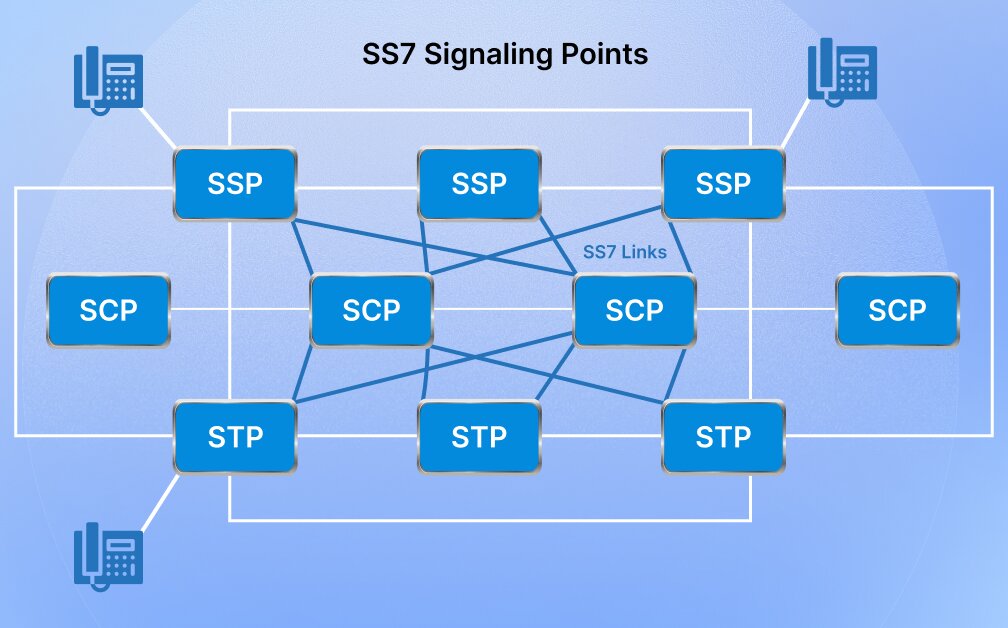
SS7 is a packet-switched, out-of-band signaling system using a layered stack (distinct from in-band tones of classic phreaking). Key nodes include:- Service Switching Point (SSP): Edge switches handling calls/SMS.
- Signal Transfer Point (STP): High-speed routers for message forwarding (often paired for redundancy).
- Service Control Point (SCP) / Home Location Register (HLR) / Visitor Location Register (VLR): Databases for subscriber data, location, and services.
Protocol Stack (MTP-based, with SIGTRAN variants over IP):
- MTP Level 1–3 (Message Transfer Part): Physical/data link and network routing (point codes, linksets).
- SCCP (Signaling Connection Control Part): Connectionless/connection-oriented routing using Global Titles (GT) for address translation.
- TCAP (Transaction Capabilities Application Part): Transaction management (Invoke, Return Result, etc.) — the layer where many recent bypasses occur.
- Application Parts:
- MAP (Mobile Application Part): Core for mobility (v2/v3 most common). Handles location updates, queries, SMS.
- ISUP (ISDN User Part): Call control (setup, alerting, release).
- CAP (CAMEL Application Part): Intelligent services, billing, prepaid.
- Others: INAP, etc.
High-level example flows (educational only):
- Location Query: Attacker sends MAP ProvideSubscriberInfo (PSI) or AnyTimeInterrogation (ATI) to HLR → returns cell ID or coordinates.
- SMS Redirection: Forged MAP ForwardShortMessage (FSM) reroutes to attacker-controlled number.
- Call Interception: ISUP Initial Address Message (IAM) manipulation or CAMEL triggers.
Modern deployments use SIGTRAN (SS7 over IP via SCTP/M3UA) for cost/efficiency, but the trust model remains identical.
3. Root-Cause Design Vulnerabilities (Unchanged Since the 1980s)
- Zero Authentication: No verification of originating node (any Point Code/GT can be spoofed).
- Plaintext Everything: Subscriber IMSI, location, SMS content, keys exposed.
- Global Interconnect Trust: Roaming agreements assume all operators are benign; GT leasing (addressed in GSMA FS.52 Code of Conduct) adds opacity.
- Protocol Flexibility for Abuse: TCAP’s encoding rules allow malformed or extended tags to evade static filters (the 2025 bypass vector).
- Interworking Gaps: SS7 ↔ Diameter ↔ 5G HTTP/2 creates translation points where protections weaken.
4. Comprehensive Taxonomy of SS7 Vulnerabilities and Attack Categories
Public research (Positive Technologies, Enea, GSMA FS.07) categorizes threats into three severity levels (Cat 1–3 in FS.11):- Location Tracking (Most Common): MAP PSI, ATI, SendRoutingInfo (SRI), ProvideSubscriberLocation (PSL). Precision: hundreds of meters in urban areas. Used for surveillance, stalking, or targeting.
- SMS Interception/Redirection: MAP ForwardSM, ReportSM-Delivery-Status. Bypasses 2FA; enables account takeovers (documented in 2024 European banking cases draining millions).
- Call Interception/Rerouting: ISUP IAM manipulation or MAP UpdateLocation to hijack calls.
- Subscriber Data Theft: MAP SendParameters, AnyTimeInterrogation for IMSI, MSISDN, profile.
- Denial-of-Service: MAP CancelLocation, PurgeMS floods; network-level via STP overload.
- Fraud & Billing Abuse: CAMEL for unauthorized charging or premium-rate pumping.
- Advanced Evasion (2024–2026): TCAP encoding tricks (e.g., extended IMSI tags in PSI Invoke, as in Enea’s July 2025 report on a Middle East vendor active since Q4 2024). These bypass legacy firewalls by altering PDU structure without changing semantics. Cross-protocol attacks (SS7 + Diameter + GTP) evade single-protocol monitoring.
Citizen Lab’s 2026 “Bad Connection” report highlighted commercial surveillance vendors (CSVs) weaponizing SS7/Diameter for global tracking of high-profile targets without device compromise.
5. Real-World Incidents and Trends (2024–Early 2026)
- 2025 Surveillance Bypass: Enea documented active exploitation of the new TCAP encoding attack by a Middle East surveillance firm — successful against select carriers for cell-level tracking despite protections.
- Banking Fraud Waves: 2024–2025 European cases used SS7 SMS redirection for mTAN/OTP theft, leading to direct account drains.
- State-Sponsored Campaigns: Suspected links to groups like Salt Typhoon targeting U.S. carriers (AT&T, Verizon, etc.) for broader signaling access and data exfiltration.
- Commercial Surveillance: Ongoing use by CSVs against journalists, activists, and executives worldwide (Citizen Lab, Enea reports).
- Probing Surge: 2025 webinars noted increased dark-web offerings and automated scanning, with firewall “leaks” still common due to incomplete filtering or GT leasing opacity.
These incidents underscore that even “protected” networks leak under sophisticated, low-volume targeted attacks.
6. SS7 vs. Successors: Diameter, 5G SBA, and Interworking Risks
- Diameter (4G LTE): IP-based with optional TLS/IPsec, but often under-configured. Shares spoofing/replay vulnerabilities; many operators fail basic filtering.
- 5G (HTTP/2 Service-Based Architecture): Introduces TLS, OAuth-like authorization, SUCI privacy. However, roaming and legacy interworking reintroduce SS7/Diameter paths.
- Reality Check: Full 5G Standalone (no fallback) is not universal in 2026. GSMA and 3GPP stress secure interworking functions, but gaps persist.
7. Global and Regional Variations in Exposure
Adoption of mitigations varies wildly: Tier-1 operators in Europe/North America deploy advanced multi-protocol firewalls; many in Africa, Asia, and Latin America lag due to cost and legacy equipment. International roaming links remain the weakest global vector.8. Comprehensive Defensive Strategies (Operator, Enterprise, and Individual Levels)
GSMA-Recommended Best Practices (FS.07, FS.11, T-ISAC):- Deploy stateful signaling firewalls with deep protocol validation, anomaly detection, and AI-driven correlation across SS7/Diameter/GTP/HTTP/2.
- Implement Cat 1–3 message filtering (block high-risk MAP ops from non-home networks).
- Enforce home routing for SMS, GT leasing transparency (FS.52).
- Cross-protocol monitoring, rate limiting, and threat intelligence sharing via GSMA T-ISAC.
- Regular ethical penetration testing of interconnects.
For Enterprises Using VoIP/PBX or Mobile-Dependent Services:
- Avoid SMS 2FA; mandate app-based or hardware keys.
- Use encrypted VoIP with SRTP/TLS; segment signaling traffic.
For Individuals:
- Prefer end-to-end encrypted apps (Signal, WhatsApp) over SMS/calls.
- Enable SIM PIN, eSIM where possible; monitor bills and usage alerts.
- Assume any SMS-based auth is interceptable.
Commercial solutions (e.g., Enea Adaptive Signaling Firewall) now offer unified, AI-powered protection with proven efficacy against 2025 bypasses.
9. Broader Impacts: Individuals, Businesses, Governments, and Society
- Individuals: Privacy erosion, financial theft, physical safety risks (stalking via location).
- Businesses: Billions in fraud losses, IP theft, supply-chain disruption.
- Governments: National security implications (surveillance of officials, critical infrastructure signaling compromise).
- Society: Erosion of trust in mobile communications; drives push for encrypted alternatives and regulatory scrutiny (e.g., FCC comments on SS7/Diameter).
10. Future Outlook: 2026–2035 and Beyond
Expect continued low-and-slow targeted attacks in 2026, with attackers shifting to Diameter/5G interworking as SS7 hardens. AI will enhance both detection and evasion. 6G promises quantum-resistant crypto and zero-trust signaling, but legacy bridges will linger. Full deprecation requires global coordination — unlikely before 2035. Positive trend: Rapid growth in signaling security market and GSMA-led information sharing.11. Extensive Resources for Further Legal, Ethical Study
- GSMA Documents (publicly accessible where noted): FS.07 (SS7/SIGTRAN security), FS.11 (firewall/monitoring guidelines), FS.52 (GT leasing code), Mobile Telecommunications Security Landscape 2025/2026 reports.
- Key Reports: Enea Threat Intelligence (2025 bypass details), Positive Technologies SS7 exposure reports, Citizen Lab “Bad Connection” (2026), ENISA signaling security analyses.
- Books & Papers: “Exploding the Phone” (historical context), 3GPP/GSMA specs, academic papers on interworking vulnerabilities.
- Communities/Events: GSMA T-ISAC (operators only), DEF CON Telecom Village (historical/ethical demos), ethical bug bounty programs from telcos.
- Certifications/Careers: Pursue telecom security tracks (e.g., via OSCP with signaling focus) for red-teaming or carrier roles.
SS7 vulnerabilities exemplify how legacy infrastructure can undermine modern security. In 2026, the “phreaking” ethos of curiosity has evolved into ethical telecom defense — pushing for resilient, privacy-first networks. Focus on building defenses, supporting standards bodies, and using secure alternatives. For expansion on any subsection (e.g., Diameter specifics or GSMA FS.11 in depth), provide more context! Stay curious, and prioritize encrypted communications.
Last edited:

