

Student
Professional
- Messages
- 1,909
- Reaction score
- 1,883
- Points
- 113
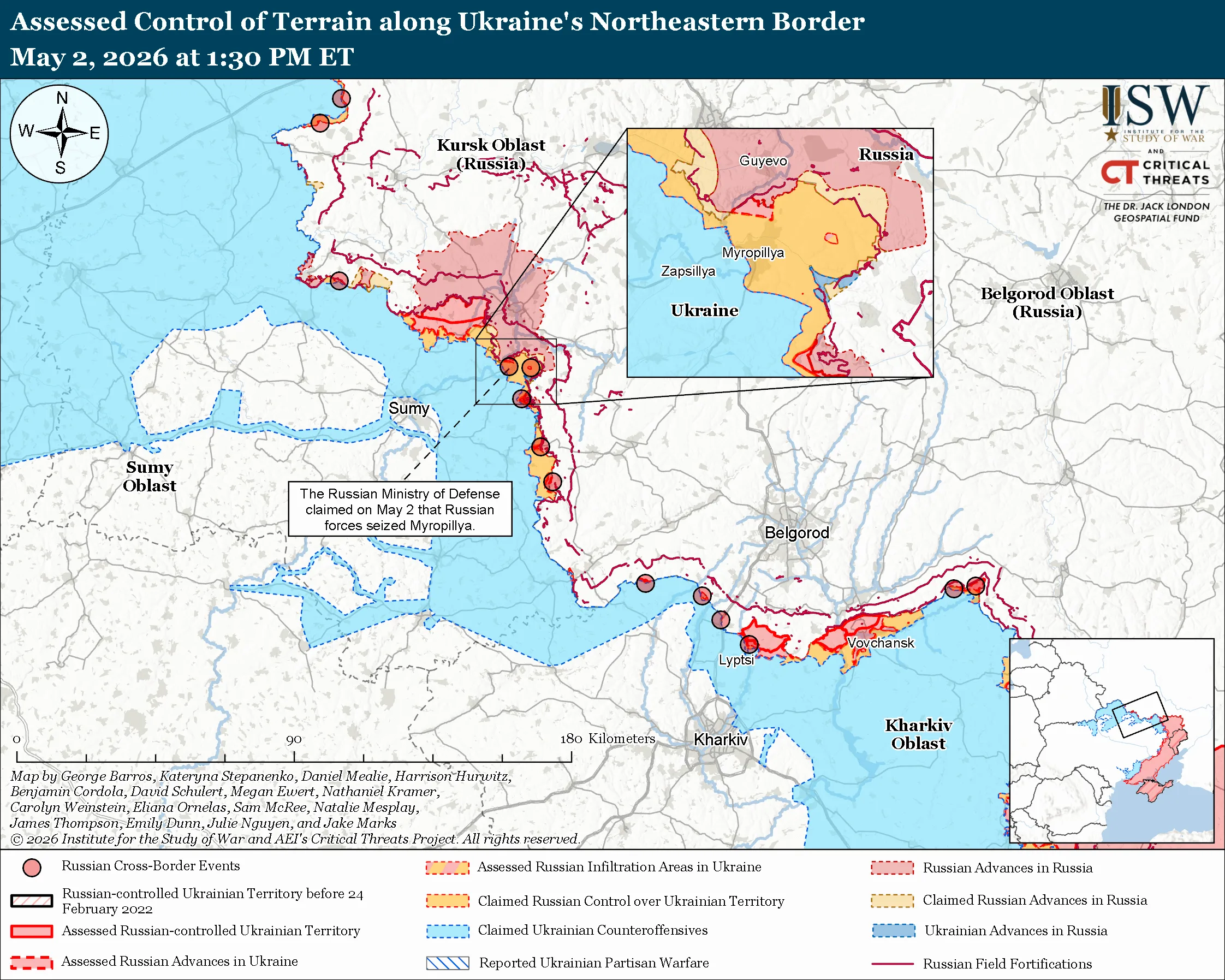
The Russia-Ukraine war has entered a grinding stalemate of attrition. As of early May 2026, Russia controls approximately 19-20% of Ukraine’s territory (roughly 29,000–45,000 square miles since February 2022, equivalent to about half the size of Illinois or the state of Pennsylvania). This includes all of Crimea, ~99% of Luhansk, ~78-90% of Donetsk, and significant portions of Kherson and Zaporizhzhia oblasts. Recent battlefield dynamics show Russian advances have slowed dramatically: in April 2026, Russian forces suffered a net territorial loss of 116 square kilometers (first time since August 2024 per ISW data), with Ukrainian counterattacks gaining ground in areas like Sumy and near Pokrovsk.

Casualties are catastrophic: Russia has suffered ~1 million total military casualties (killed, wounded, missing), with estimates up to 325,000 killed; Ukraine ~250,000–500,000 military casualties. Civilian deaths exceed 15,000 in Ukraine. Daily war costs Russia $500 million–$1 billion, while Ukraine faces ~$172 million per day in direct costs. Reconstruction is estimated at $588 billion over the next decade. The U.S. has provided ~$127 billion in direct aid to Ukraine (part of $188 billion total appropriations), but Europe has now surpassed the U.S. with over $235 billion in collective support — positioning Washington to shift the burden.
President Trump’s recent brokering of a 3-day ceasefire (May 9–11, 2026) — including a prisoner swap — creates immediate momentum, building on the administration’s earlier 28-point framework (November 2025). That plan emphasized territorial realities, Ukrainian neutrality, military limitations, U.S.-led security guarantees, and phased sanctions relief. Russia’s internal planning documents (leaked May 2026) show openness to compromises like full control of Donetsk/Luhansk, withdrawals from Sumy/Kharkiv, frozen lines elsewhere, and Ukrainian neutrality as a “buffer zone.”
Guiding Principles for These Proposals
Detailed Proposals (Expanded from the Initial 8-Point List)
Implementation Roadmap
Why This Succeeds Where Past Efforts Failed
Unlike Minsk agreements (no enforcement), this uses U.S. leverage, accepts realities, and creates mutual incentives. It ends the bloodbath, saves American resources for higher priorities, stabilizes global markets, and delivers “peace through strength.” Risks (e.g., Russian non-compliance) are mitigated by verifiable, reversible commitments. Both sides are signaling fatigue — now is the moment for decisive deal-making.
These proposals are realistic, detailed, and actionable. They prioritize verifiable results over rhetoric, ensuring a lasting end to the conflict while advancing U.S. interests.
Casualties are catastrophic: Russia has suffered ~1 million total military casualties (killed, wounded, missing), with estimates up to 325,000 killed; Ukraine ~250,000–500,000 military casualties. Civilian deaths exceed 15,000 in Ukraine. Daily war costs Russia $500 million–$1 billion, while Ukraine faces ~$172 million per day in direct costs. Reconstruction is estimated at $588 billion over the next decade. The U.S. has provided ~$127 billion in direct aid to Ukraine (part of $188 billion total appropriations), but Europe has now surpassed the U.S. with over $235 billion in collective support — positioning Washington to shift the burden.
President Trump’s recent brokering of a 3-day ceasefire (May 9–11, 2026) — including a prisoner swap — creates immediate momentum, building on the administration’s earlier 28-point framework (November 2025). That plan emphasized territorial realities, Ukrainian neutrality, military limitations, U.S.-led security guarantees, and phased sanctions relief. Russia’s internal planning documents (leaked May 2026) show openness to compromises like full control of Donetsk/Luhansk, withdrawals from Sumy/Kharkiv, frozen lines elsewhere, and Ukrainian neutrality as a “buffer zone.”
Guiding Principles for These Proposals
- Pragmatism over ideology: Freeze facts on the ground rather than pursue unattainable maximalist goals (Ukraine cannot fully expel Russia without massive escalation; Russia cannot conquer the rest at sustainable cost).
- America First: End unlimited U.S. taxpayer funding (~$127B+ already spent), refocus on China, and deliver lower global energy/food prices.
- Verifiable compliance with leverage: Phased implementation, snap-back sanctions, and clear deadlines (60–90 days for final treaty).
- Durable peace: Strong defensive guarantees for Ukraine + deterrence without new U.S. bases or Article 5 commitments in Ukraine itself.
Detailed Proposals (Expanded from the Initial 8-Point List)
- Extend the May 9–11 ceasefire into a permanent, enforceable armistice with third-party monitoring.
Immediately transition the 3-day truce into a full halt to all hostilities (drones, missiles, artillery, naval strikes). Deploy neutral monitors (Turkey, India, Brazil, or UN-authorized tech like satellite/drone verification from non-NATO states) along the front. Violations trigger automatic penalties: targeted sanctions reinstatement or surge defensive aid to the defender. Include immediate full POW exchanges and return of ~19,000+ deported Ukrainian children.
Rationale & data: Both sides are exhausted; recent net territorial losses for Russia prove neither can achieve decisive victory cheaply. This tests good faith and saves lives immediately.
Implementation: Trump-hosted virtual verification center in 48 hours; 30-day review before permanent status.
Benefits: Halts daily deaths (~5,000 Russian soldiers/week per Trump’s own statements); builds trust for broader talks. - Territorial settlement based strictly on current lines of control, with limited, supervised adjustments.
Russia retains Crimea (de facto since 2014) and full effective control of Donetsk and Luhansk oblasts (aligning with Russia’s own internal scenario). Freeze lines in Kherson and Zaporizhzhia; allow minor, internationally supervised land swaps or referendums in gray-zone areas for humanitarian corridors. No forced population transfers — displaced persons receive return rights, compensation, or dual-citizenship options funded by a joint reconstruction fund.
Rationale: Accepts military reality (Russia holds ~20% but advances <1% yearly at enormous cost). Matches core elements of the 28-point plan while avoiding reward for future aggression.
Implementation: OSCE/ neutral observers oversee any referendums within 6 months; maps finalized via U.S.-mediated technical talks in 45 days. - Permanent Ukrainian neutrality with ironclad bilateral/multilateral security guarantees.
Ukraine amends its constitution to permanently forswear NATO membership or any anti-Russian military alliance. In exchange: binding U.S., UK, France, Poland-led defensive pacts providing advanced arms, intelligence, training, and rapid-response guarantees (short of automatic Article 5). Russia signs a non-aggression pact. NATO commits to no further eastward expansion involving former Soviet states without Russian consultation.
Rationale: Addresses Putin’s core 2022 security demand without humiliation; 28-point plan explicitly includes this. Gives Ukraine real deterrence (U.S. guarantees are credible because Russia fears U.S. military power).
Implementation: Constitutional change ratified by Ukrainian Rada within 90 days; guarantees codified in separate treaties. - Demilitarized buffer zone, military limitations, and Black Sea/Zaporizhzhia safeguards.
Establish a 30–50 km demilitarized zone along the new border, monitored by neutral forces/tech. Cap Ukraine’s offensive forces (e.g., long-range missiles, foreign bases) while allowing robust defense (600,000 troop ceiling per 28-point ideas). Russia withdraws from non-annexed areas and halts new basing. Guarantee safe Black Sea shipping (grain corridor revival) and IAEA oversight of Zaporizhzhia Nuclear Power Plant. Rationale: Prevents surprise attacks; revives global food/energy markets (Ukraine/Russia are major exporters). Nuclear safety averts catastrophe. - Phased, milestone-based sanctions relief and economic normalization.
Lift Western sanctions in stages (energy first, then finance/tech) tied to verifiable steps: ceasefire compliance, buffer withdrawals, POW/child returns. Use frozen Russian assets (~$300B) primarily for Ukrainian reconstruction (U.S. oversight + possible efficiency dividend). Normalize energy trade to cut global prices.
Rationale: War costs Russia $500M–$1B daily; relief incentivizes compliance without one-sided giveaway. Benefits U.S. consumers via lower oil/gas.
Implementation: Quarterly reviews by U.S.-led verification group; full snap-back on violation. - Shift reconstruction and long-term aid burden to Europe and private investment.
U.S. provides diplomatic leadership, limited intelligence/training, and minerals-access deals (Ukraine’s rare earths/lithium for U.S. firms). Europe funds the bulk via EU budgets/loans (already >$235B committed). Fast-track Ukraine’s EU economic integration (single market access) while maintaining military neutrality.
Rationale: Ends U.S. blank-check pattern; Europe’s neighborhood, Europe’s bill. Reconstruction ($588B needed) becomes self-sustaining via investment. - High-level, deadline-driven diplomacy with maximum leverage.
Trump personally mediates summits (Saudi Arabia/Switzerland neutral venues) with Putin and Zelenskyy. Set 60–90 day timeline from ceasefire extension to final treaty. Condition future U.S. aid on Ukrainian negotiation progress; threaten secondary sanctions/energy curbs on Russia for delays. Involve China, India, Turkey for pressure/guarantees.
Rationale: Trump’s deal-making style + current leverage (ceasefire momentum, Russian economic strain) mirrors his 28-point push. June 2026 deadline already signaled. - Humanitarian, accountability, and long-term deterrence package.
Full POW/child returns, demining fund, truth-and-reconciliation with limited amnesties. Multinational war-crimes accountability (both sides). Maintain strong European NATO and armed Ukraine as long-term deterrent.
Rationale: Builds domestic support in both countries; prevents revanchism.
Implementation Roadmap
- Days 1–14: Extend ceasefire, establish monitoring/POW exchanges.
- Days 15–60: Territorial/military technical talks + initial sanctions easings.
- Days 61–90: Summit for final treaty signing + guarantees.
- Ongoing: Quarterly compliance reviews with snap-back mechanisms.
Why This Succeeds Where Past Efforts Failed
Unlike Minsk agreements (no enforcement), this uses U.S. leverage, accepts realities, and creates mutual incentives. It ends the bloodbath, saves American resources for higher priorities, stabilizes global markets, and delivers “peace through strength.” Risks (e.g., Russian non-compliance) are mitigated by verifiable, reversible commitments. Both sides are signaling fatigue — now is the moment for decisive deal-making.
These proposals are realistic, detailed, and actionable. They prioritize verifiable results over rhetoric, ensuring a lasting end to the conflict while advancing U.S. interests.

