

Brother
Professional
- Messages
- 2,590
- Reaction score
- 544
- Points
- 113
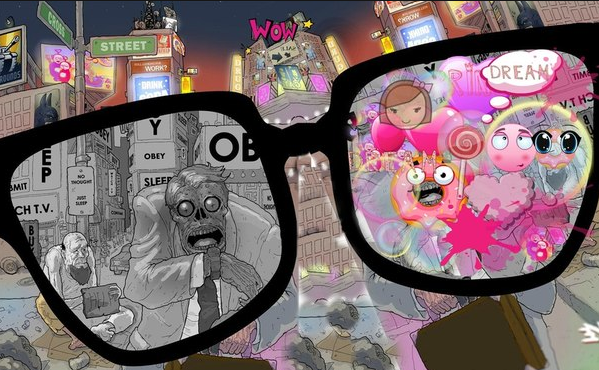
How does subjective reality arise?
In our perception, information undergoes at least three stages of distortion.
(1) The sense organs give information the form that is physiologically characteristic of the given sense organ. At this level, our perception is a mass of sensations .
(2) The cultural environment (upbringing and education) already in the first years of life teaches us to single out individual objects from the mass of sensations. As a result, the world appears to us as a collection of objects. This is the level of the so-called objective perception .
People living in the same cultural environment easily come to an agreement at this level. Objective reality, ie objects and processes occurring with them are a common reality for people.
An objective picture of what happens at a certain moment, in a certain place, will be called a situation.
(3) Further, the intentions of the perceiving subject make him pay attention to only a part of the existing objects and perceive the situation in a distorted manner (in accordance with his intention). The perception of a person becomes different from the perception of other people. This is the level of subjective perception . This is exactly what it is in most cases for most people. This subjective perception becomes the reality in which a person lives.
The subjective perception of the situation will be called the context. There is an intention behind each context, which leads to this perception of the situation.
Views are patterns of perception
When a child learns to recognize and name objects, he creates many reference images, which later serve as the basis for his perception of the world. Representations are previously fixed patterns of perception of objects and situations.
Perceiving objects, a person recognizes in them what is familiar to him, and in the place of the object he usually sees an image embedded in his memory. Thus, everything that a person usually sees with his eyes is the result of the work of his ideas.
When a person perceives an object, the idea of this object turns into an active state. An intermediate phase between the active and inactive state of the presentation - when a person thinks about the presentation, but is removed from it so that it does not affect his feelings. A representation is completely inactive when a person has not in any way called it up in his memory.
Various performances are organized in the inner world like air "bubbles" floating in a transparent liquid. Each "bubble" is a concept that has emerged and has become entrenched in the process of life. Some of the "bubbles" are close in the field of human attention, while others are on the periphery. A person can attract any of the "bubbles" to him if he keeps his attention on it. The "bubble" will approach, and a person will see the world around him through its walls, which will shape his perception in a certain way. In this case, feelings, thoughts, behavior (that is, all experience) will fully correspond to this perception.
Integrity of experience
Experience is the experience of a person at a certain point in time in a certain situation in its entirety .
The natural components of experience are feelings, thoughts, actions, and perceptions . Experience is holistic , ie feelings, thoughts, actions and perceptions in it are interconnected. By changing one, we induce changes in the rest of the components. When solving psychological problems, in order to ensure the preservation of the changed experience, it is necessary to change all its components.
We will call a complete description of an experience a description of all its components. We will use the full description to enhance the experience of the new experience and thus program its appearance in reality.
Three types of relationship to experience
Any experience that a person experiences can be fixed. Consolidation occurs through the acceptance of one or another attitude to this experience.
The three main types of relationship to experience are: (1) "closeness" - denial or avoidance (lack of awareness), (2) " focus" - aspiration or desire (consciousness directed at the object), (3) " openness" - involvement or acceptance (wide awareness of the entire context). In any anchored experience, there is some kind of fixing relationship or all three.
Three types of fixing relationship correspond to three types of psychophysiological state, which are manifested in bodily sensations. Closedness - tension, immobility, hardness, stiffness (state of "stone"). Direction - activity, movement, excitement (state of "fire"). Openness - lightness, relaxation, calmness (state of "water").
For an external observer, these states are manifested in a different nature of motor expression, as well as in a person's speech - in what he is talking about. In a closed state, a person says that he does not accept something, that he avoids something, prefers not to notice something .... In speech he uses the negation "not", "not allowed", "impossible", "unacceptable "," awful "," disgusting "," bad "," just not "," get rid "," prevent "....
In a state of focus, a person talks about desires, goals, values, actions and motives , about some significant objects .... In speech, he uses the words "I want", "desirable", "good", "better "," great "," great "," ideally "," main "," most "," most important "," important "....
In a state of openness, a person talks about what is, about accepting something, about being involved in something , about real involvement in something , about responsibility to something ( someone ) ... In speech he uses words "must", "must "," must "," must "," correct "," appropriate "," appropriate "," we "," together "," together "," simply "," is "... ...
Thus, the type of fixing attitude can be determined both by the description of the experience and by the internal sensations at the moment of perception of the experience.
What is a psychological problem?
A psychological problem will be called inadequate perception and, as a result, inadequate response to a situation. The core of the psychological problem is anchored past experience. The solution to the psychological problem is to de- fix the experience and change it to a more adequate form.
Unlock fixed experience is possible by means of awareness. Awareness procedures will differ when dealing with different types of fixation.
De-fixing the accepted reality
Openness or a state of acceptance (inclusiveness, involvement) arises as a result of a decision about the reality of something, the inevitability of something, or being connected with something.
Reality is the interaction of a person and something (someone) that a person considers reality (recognizes as reality). Realizing reality means realizing with whom (with what) I interact and what this interaction is like. Namely, what I do, and what it seems to me that someone (something) is doing in relation to me. Awareness of interaction automatically takes a person out of the experience of belonging to him, and the experience goes into a free state called flexibility .
A person's actions in relation to reality are a consequence of his perception of reality. To find out what this perception is, one must ask the question: "Why are you doing this?" The answer will be the person's belief about reality, which makes him do what he does.
To free oneself from the "hypnosis" of a problematic reality, it is necessary to formulate an antithesis, opposite in meaning to a limiting belief, and pronounce it with full attention.
The exercise. Resource installation
Choose a context in which there is frustration, apathy, or feelings of helplessness, hopelessness.
1. Think about this context. Strengthen your feelings for a while, trying to experience them deeper. Be aware of the subject of frustration (helplessness).
2. Become aware of your feelings, thoughts and actions in this context. "Take off" them like old clothes and "fold" them at a distance from you. Feel that your body and breath are free of them.
3. Notice other elements of the situation and your interactions with them. What are you doing, and what, from your point of view, are they doing in relation to you?
Find out your limiting belief in reality. Why are you acting like this?
Find other situations where you have experienced a similar relationship with someone (something). Realize that you yourself create by your actions what you consider to be reality.
4. Formulate the resource attitude as the antithesis of the limiting belief.
Say the installation. Does it make you feel better?
What behavior is appropriate for a given resource setting? Make the decision to deliberately pronounce the resource attitude several times and use this behavior when faced with this situation.
5. Notice what changes have occurred in your reaction to this context.
De-fixing the avoided reality
When there is stiffness, tension, or a state of fear, the source of these emotions is certain events that, for whatever reason, the person does not want to allow. But man is not afraid of the avoided fact itself, but of the subjective meaning that he attaches to the fact. It is known that for a person his fantasies are the worst of all.
Closure or a state of avoidance arises from a decision that something in the experience is unacceptable. That part of the experience that does not suit a person for some reason will be called a symptom .
To unlock the closedness, one should join the symptom (the rejected part of the experience). That is, deliberately reproduce, imitate, depict or describe in detail and express all the emotions that arise in this case. You can portray, imitate both your own unacceptable actions and the rejected behavior of other people.
Joining a symptom removes a negative emotional charge, allows you to rethink the rejected experience (partially accept it) and calmly react to it in the future.
The exercise. Unlocking the closed
Choose a situation in which you are experiencing feelings of stiffness, tension, or fear.
(Do not take situations with very strong fears. If, in addition to tension and stiffness, other strong emotions arise, then it is better to do the technique "Completing the intention of an imprint context" with it.)
1. Think of this situation as if you were in it now. Notice the feeling of stiffness in the body. Become aware of what you are avoiding (and what you fear when you avoid it). Distinguish between the real possible and the fiction. Find examples in your past.
Continue to be aware of what you are avoiding in these situations until the tension and stiffness go away and you realize that what you were avoiding is not really as scary as you thought.
2. Now consciously do or imitate what you were avoiding.
3. Notice what changes have occurred in your reaction to this context.
Unfixing the desired reality
If a person stubbornly strives for something (no matter whether it is good or bad), if in some situations he experiences the emotion of anger, anger or irritation - all these are manifestations of a fixed aspiration.
The basis of a fixed aspiration is an ideal that is objectively impossible to realize at the moment. The cause of anger, irritation or anger is the mixing of ideal and reality - ie the claim that the ideal should be fulfilled immediately.
So, focus or fixed aspiration arises as a result of a decision about the importance of something absent (or not fully present) in the present. Direction is unfixed by experiencing the full realization of the intention (even if only mentally). The experience of the desired, as if it has already been fully achieved, and a detailed awareness of this result frees consciousness from fixation and makes it possible to feel the freedom of choice.
The exercise. Directional unlocking
Choose the context in which you are experiencing anger, irritation, or anger.
1. Remember this context and enter this state. Strengthen the state, while being aware of the subject of your irritation.
2. Think about what you would like ideally. Imagine the most beautiful picture of what you want without limiting yourself.
Imagine and experience as fully as possible that you have achieved what you wanted. Does this completely satisfy you? What is important (most important) to you about this result?
3. Pay attention to the real reality and describe how reality differs from the ideal.
4. Decide for yourself if you want to continue to strive for this ideal.
(4a). If not. Do you have the opportunity (to some extent) to have the most important thing in this result in reality?
(4b). If yes. Think about what you need to do to get closer to him.
5. Notice what changes have occurred in your reaction to this context.
Reality design
Perception of situations is created by ideas about these situations received in the past. Consequently, any perception of reality is a search for an answer to the question, "What does this reality look like?", And any idea of reality is a metaphor .
Ask yourself what a problem situation is like and you can easily find a metaphorical image for it. While these comparisons are often ridiculous from a common sense point of view, they should be taken seriously. Is it possible to control this process? What happens if you compare the situation with another metaphor that is more appropriate for the given situation?
To change a concept that has served a person for a long time, it is not enough for him to agree with a new point of view. After all, the old idea arises automatically even before a person has time to think about anything. In order to create a new image of the situation and limit the action of the old image, it is useful to mentally transform the old metaphor into a new one several times, much like a computer transforms one picture into another.
Whatever the old idea of reality may be, it has the right to exist in a certain suitable situation, at least in the one in which it appeared. To limit the effect of the old idea, it should be contextualized , namely, to identify situations in which it is appropriate. In the same situations where it is inappropriate, you should adjust the idea, focusing on your inner feeling.
The exercise. Creating a metaphor for reality
Part 1. Creating a metaphor for reality
Choose a problematic context in which you are not comfortable with the situation itself, or your condition, or your behavior.
1. Become aware of your experience in this context. How do you feel? What do you think? What are you doing?
2. "Take off" this experience from yourself like old clothes and "fold" at a distance from you. Feel that your body and breath are free of them, change your posture.
3. Notice other elements of the situation and your interactions with them. What are you doing, and what, from your point of view, are they doing in relation to you? What does this interaction look like? Create a mental symbol (caricature) of this interaction.
4. Find out your limiting belief in reality. Why are you acting like this?
Say the antithesis to the limiting belief, feel how it affects your condition.
5. Contextualize the old reality. In what situations (circumstances) is this interaction option appropriate? Is the old reality relevant to the present situation (s)?
6. Create a metaphor for the new reality. What is the more appropriate metaphor for interaction in this situation? Find a new symbol of reality. Smoothly transform the old symbol into the new one (3 times).
Bring the metaphor of the new reality closer to you. Feel what state it causes in you.
Part 2. Adjusting to the future situation
In a future situation, pay (conscious) attention only to the content of the situation and your purpose in it. Everything else in the experience will be regulated unconsciously.
7. Mentally enter the future situation. Let your conscious attention be occupied only by the situation. Present and describe the situation at the environmental level. What does it have? What's going on in it? At the same time, you do not need to talk about your feelings, thoughts, or anticipate your behavior. Just notice what will happen involuntarily.
Compare your sense of self with that which was in this situation before.
8. After completing the review of the situation, describe how you felt, what you thought, what you did and what you paid attention to in this situation.
Find the gesture (posture) that you associate with this state.
Reimprinting the experience
Usually the experience becomes strong and stable after a lot of repetitions. Each time, finding himself in a situation that a person is aware of as familiar, he repeats the experience that was fixed earlier, turning it into an increasingly stable habit.
However, not only repetition, but also the intensity of the experience affects its durability. There are times when the experience is imprinted for a lifetime at one time. This happens when what is happening affects something vital to a person. Then the imprinting of the experience occurs so strong that the experience then unconsciously affects the behavior and feelings of the person for the rest of his life, and it is much more difficult to change it than any habit.
An imprint is a one-time, powerful imprint of an emotional experience. In the future, he makes the person again perceive a variety of situations in the same way as he perceived the previous situation. An imprinted experience can persist throughout one's life even if it is completely inconsistent with the subsequent life circumstances of a person.
In a person's life, imprints, due to their strength, begin to interfere with adaptation rather than help, since they deprive him of the flexibility so necessary in human society.
The exercise. Completion of the intent of the imprint context
Think about the situation you are experiencing as a dead end, confusion. Get out of this situation by seeing it from the side.
1. Become aware of the negative experience in this situation and its intention. What do you want in this situation? What do you feel? what are you paying attention to? what you are doing? what are you thinking about?
Find a metaphor for your actual behavior in this situation. What does it look like?
2. Find the situation in the past that created this experience (imprint context), or the strongest experience of this experience. In what situations have you had similar experiences in the past? Who were the actors in this situation? What were their intentions?
3. See the past situation as "as if". How would it be if this intention of yours was fulfilled in the imprint context?
Enter the situation and live it as if. How would you feel? Would you have any next intention after this intention is fulfilled? Imagine fully fulfilled all the intentions that arise. Notice the emergence of a state of harmony in yourself. Stay in this state in this situation as long as it gives you pleasure.
Quickly replay the past situation three times in a variant when your intentions are fully fulfilled, each time imagining it more vividly. Maintain this state of harmony until the end of the exercise.
4. Return to the present. Compare the present problem situation and the past (imprint) situation. Find their objective similarities and differences until both the past and the present situation begin to be perceived calmly, and the number of differences exceeds the number of similarities.
5. Choose an intention that is more relevant to the present situation than the previous one. Find a new belief (why would I do this?).
Choose a new, more appropriate metaphor for this situation. Transform the image of the old metaphor into a new image several (3-5) times quickly. Bring the image of the new metaphor to yourself.
6. Go to the future in your mind. How has your sense of self changed?
Live 2-3 future situations like the one in which you felt the problem before. After completing the first one, describe how you felt, what you thought, what you did, and what you paid attention to in it.
The structure of the psychotherapeutic process
In a conversation with a client, it is best to talk about how his problem is manifesting at the present time, and what he wants to get as a result of working on the problem. In order to notice fixed notions behind the external difficulties that the client talks about, one must be attentive to everything that he somehow avoids , desires, or believes in . To do this, notice the labeled phrases, as they communicate the presence of a fixed reality. Pay attention to words and phrases (above) that speak of avoiding, wanting, or accepting something.
Pay attention to non-verbal manifestations of the client's condition. Poses, movements and emotional expression communicate a state (of "stone", "fire" or "water") and, at the same time, a type of fixed reality. Stillness is about avoidance; mobility and emotionality - about striving; relaxation, apathy or calmness and confidence - about accepting something.
Strong emotions (tears, confusion, impasse) indicate that you have encountered an imprint.
Notice all the fixed realities, and then decide which ones are directly related to the client's stated problem.
During the consultation, you can directly ask the client the following questions. (a) What would be most undesirable in this situation? What would you like to prevent (in any case)? (b) What would you like in this situation (if everything was possible)? What would you like ideally? (c) What do you know exactly (about this situation)? What are you sure?
Usually, the problematic reality is fixed not by one, but by all three types of fixation at once. When unlocking it, the client's state naturally goes through the following stages. Psychologically admitting an avoidable reality, the client reveals his fixed aspirations behind it, and after liberation from them, it becomes possible for him to change his beliefs. Only after de-fixing the old reality is the client ready to define a new desired reality for himself. The next task of the consultant is to guide the client through the process of consolidating the new reality, that is, to help him choose more adequate (corresponding to his life situation and goals) objects for avoidance, desires and faith than those that were in the problem.
The exercise. Harmonization of experience
1. Choose a situation in which you would like to change your experience. What's going on in it? What are you doing? Why? (What does reality do to you? Why?)
How do you feel when you think about this situation?
2. What do you dislike about this situation? What would you like to avoid? Describe, express your feelings and separate reality from fiction. Should I avoid this? (If necessary, depict what you are avoiding several times.)
3. Describe what you want in this experience. Imagine that you have done whatever you want (to get full satisfaction with the result).
Describe what will happen then, and what is most important in this result. Describe what your relationship to reality will be. Is there (is it possible) such an attitude at the present time to any extent? Is it appropriate in the present?
4. (Optional step.) Create a metaphor (image) of a new relationship to reality. Create an image of the old (problematic) relationship. Transform the old image into the new one 3 times.
5. List what and how to do with this attitude to reality. Why? Make a decision to act like this.
6. List what should be avoided in this attitude to reality. Make a decision not to let this happen.
7. Describe what kind of ideal you should strive for with this attitude to reality. Make a decision to strive for that ideal.
8. Imagine a future encounter with this situation. How do you feel in her now?
Author: Salikhov Boris Akhatovich, psychologist, NLP master, trainer


