Brother
Professional
- Messages
- 2,590
- Reaction score
- 544
- Points
- 113
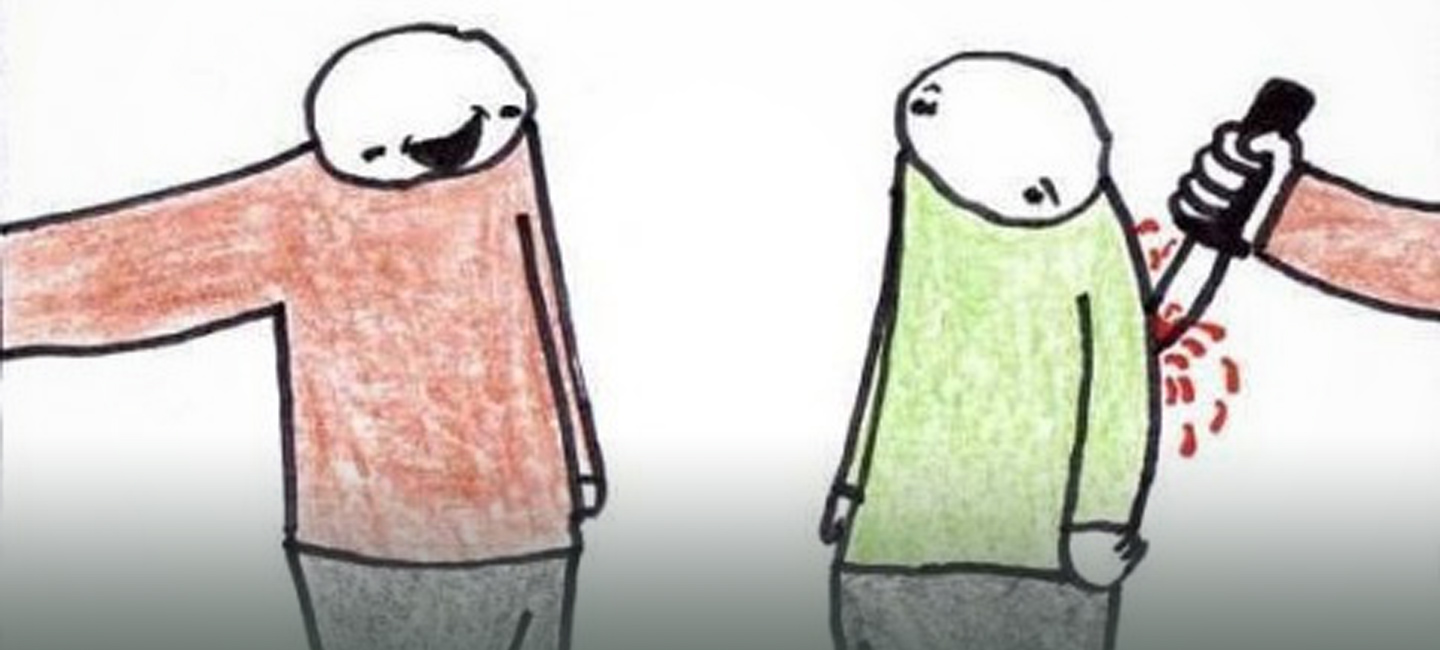
PA mimics like a chameleon, into socially approved forms of interaction, so it can be difficult to recognize her right away, she hides behind laughs or seeming care, phrases like “yes, I just shared my feelings”, “you think, what's wrong with that ”,“ you're exaggerating everything ”,“ You misunderstood everything ”,“ I was just joking. "It is not for nothing that such aggression is also called enveloping violence.
What is it and how to recognize it - this is my thinking.
First of all, I want to outline what is meant by the concept of "aggression". Aggression is the threat of violation or the very violation of my personal boundaries (physical and psychological). Direct or explicit aggression is expressed in insults, physical attacks, threats to safety and well-being, intimidation, destructive criticism, blackmail, frightening displays of anger (smashing dishes, slamming doors, breaking walls with a fist, etc.).
My main difficulties with identifying passive aggression are due to the fact that it is so veiled by seeming care and everyday actions that it can be oh so difficult to discern aggressive influences under this veil.
For example, my friend is the sweetest person and wishes me well in every possible way, but only I don't want to communicate with her at all, I myself don't understand why I behave like an ungrateful bastard (I avoid communication) , I feel uncomfortable, uncomfortable next to her, for some reason For reasons I do not understand, I feel dislike and anxiety towards her.
Now I understand that every time we communicate, my boundaries and my sense of my own dignity have come under veiled attacks.
The foundation of the PA is a wide variety of small actions of the aggressor to undermine the victim's confidence, create in her a sense of helplessness, confusion, anxiety, humiliation, coldness and guilt, hopelessness, insecurity, depression, isolation. In this state, a person can easily be taken under control, undermine his self-esteem and self-esteem (especially with prolonged interaction).
There are several types of PA or enveloping violence (Sei Vaknin):
1. Gaslighting is a term often used by mental health professionals to describe manipulative behavior, the purpose of which is to sow doubts in another person about the reality of what is happening and their own perception of reality, making a person "crazy".
The aggressor convinces the victim that she is deluded in her thoughts and feelings about herself or her life. That they are unnatural and caused by fatigue, magnetic storms, misunderstandings, lack of competence, latent mental illness, etc. That is, everything that causes discontent in the victim is immediately explained by the aggressor. Gradually, the victim begins to put up with the fact that something is wrong with her, which does not allow her to really look at things. She recognizes the power of the aggressor, because as soon as he correctly understands what is happening.
The name comes from the movie Gaslight (1944). The girl becomes a witness to strange recurring phenomena, while her husband, whose actions are caused by these phenomena, assures that everything is imagining to her, and almost brings it to psychosis.
Probably, many of us have come across such statements as: "you complicate everything"; "you think so because you are depressed"; "you react too sharply to ordinary remarks." you are fat (fool, "blue stocking", slob, substitute the right one) "," you always make an elephant out of a fly ", as well as other types of phrases, like" you can't cope without me " or "who needs you besides me".
The worst thing about such phrases is that they hit self-esteem and shift the perception of oneself. As a result, even a smart and strong person may doubt his own adequacy and his abilities, and a weak person may break down altogether.
Now, in many cases, the problem is not with you. Rather, your real problem is that you have contacted a manipulator. What is sad is this technique is very often used by men in relation to women.
2. Witholding
this includes measures on the part of the aggressor that prevent the victim from expressing their thoughts and emotions in any way. They are forcibly detained.
These are actions such as:
- "boycott" (refusal to communicate),
- depreciation of emotions ("only idiots laugh at such jokes"),
- devaluation of hopes and plans (“you seriously think that you can”, “how can you dream of this”), achievements (“any fool can do that”),
- cruel jokes,
- blocking communication (changing the topic, distraction to extraneous things during a conversation, making a serious conversation a joke, postponing the conversation for later),
- accusation (when you start talking about your problems, you upset me and my pressure rises),
- criticism (if you have such thoughts, then you are not good enough (you are doing something), you have to do something completely different),
- denial of previously existing facts that caused negative emotions of the victim,
- labeling ("you say so because you are an idiot").
As a result of these measures, the victim begins to limit himself in expressing his opinions, emotions, desires and plans, as stupid, incomprehensible, inappropriate, unimportant. Those. forced to keep them.
This also includes actions such as:
- "wound by honesty" (don't be offended, but I'll tell you to be honest);
- ignoring; invasion of privacy (“I just cleaned your desk a little and read your personal diary a little, and why are you writing something indecent there that you can't read \ yes I read your SMS / chat messages you hide from me);
- high expectations (“you have to do much more because you have the ability to do that);
- tactlessness (inappropriate remarks, questions: "why do you still have no children"),
- actions, wishes ("you should write something completely different and not about that"),
- advice ("I would be in your place"), regrets ("In fact, I feel sorry for you"),
- unsolicited stories about their experiences; humiliation; shaming;
- dissemination of information of an intimate nature;
- the creation of various difficult situations in order to test the victim;
- control through other persons (for example, asks to keep an eye on the neighbors, where and with whom the victim goes);
- not required care;
- unnecessary gifts, which are then required to use;
- hinting actions (for example, demonstrative removal of knives when a person is experiencing a breakup or quarrel). The victim has a feeling of inconvenience for the manifestations of his life, since these very manifestations cause a negative reaction from others. You have to make excuses for your feelings and actions, or, in order not to make excuses, it is better to hide it altogether. © gutta_honey
As a result, a person becomes isolated from himself, he can no longer trust his feelings and sensations, cannot defend himself, which means that he becomes unarmed against the attacks of the manipulator.
3. Blanking - means denying the value of another person, neglecting her, denying her help, sharing responsibilities, support. For example, a person fails the victim, does not attend an important meeting, does not provide the necessary documents, the husband refuses to allocate money for the necessary help) to a wife who is not working and sitting with a small child, because he does not consider this need important. And his money! The husband refuses any help to his wife with children, arguing that this is a woman's work. Parents refuse to take into account the interests of an adult child, independently rearrange furniture in his room, make repairs there at their own discretion, and, for the desired amount, throw out his things, deemed unnecessary. Unexpected arrivals of mothers to visit without warning and taking into account the time and the possibility of adult children (yazhem). © gutta_honey
In addition, I would like to separately talk about this type of PA as the aggressor throwing out his negative feelings in order to influence the behavior / attitude / opinion of the victim. A kind of manipulation on the topic "I-just-want-to-share-my-feelings with you." Such aggression is very difficult to detect because it hides in the skin of caring and creating intimacy. However, if after such a feedback you feel anger, anger, powerlessness and guilt, then you have been subtly manipulated.
What to do?
It is important to remember one very valuable thing - you are not responsible for the feelings of other people. They have the right to feel whatever they want about you, your character, responsibilities, appearance, etc., but it is THEIR responsibility to do something with their feelings. You don't have to run and stumble, changing yourself or your behavior to feel good, easy, simple, and comfortable. If a person makes you responsible for his feelings, bad mood, experiences - he manipulates you.
Passive aggression is much more common than explicit aggression. Its goal is "the collapse of the psychological boundaries of the victim." Sometimes it acts much more destructive than open aggression, since the victim cannot always defend himself, recognize hostile actions. PA inflicts especially great damage on those who, due to their personal characteristics and childhood traumas, feel that they are not so good and not so valuable in themselves, that it is ugly or wrong to resist, defend and resent, because they want me to do well / "the opposite. communication is given" / "they tell the truth."
Therefore, the answer to the question "what to do?" there will be one - to allow myself to have boundaries and the right to defend them, as at the moment I consider it necessary. For me, this is a long and difficult process: separating my own from others, setting up barriers, protecting my borders, being attentive to what is happening in any of my relationships, forgiving myself if I didn't manage to take care of my well-being right away.