

Brother
Professional
- Messages
- 2,590
- Reaction score
- 544
- Points
- 113
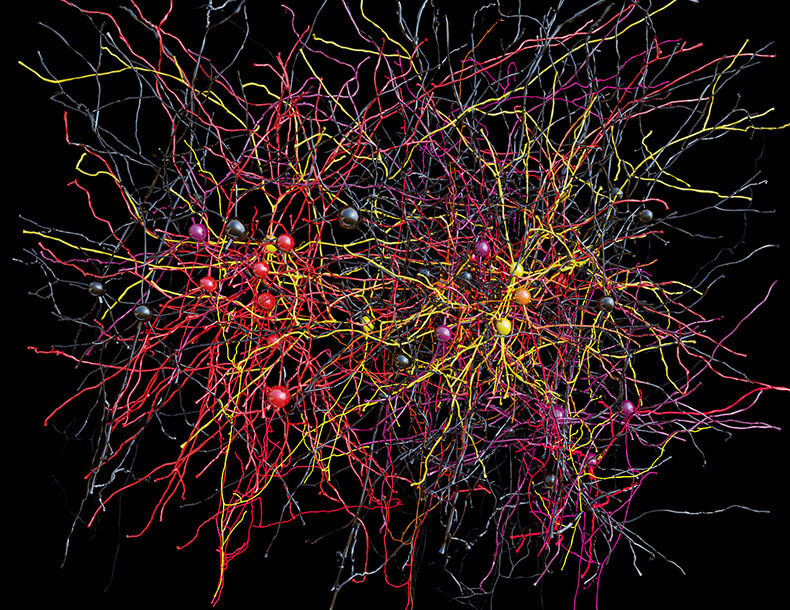
A neuron is a structural and functional unit of the nervous system. This is how a neuron is called names on Wikipedia.
In general, all elementary cells are similar in structure. Sheath, cytoplasm, nucleus with nucleolus. Like an amoeba without some details. By the way ... The membrane of the neuron is made up of lipids (essentially fat). The neuron receives nutrition through the membrane. It allows fat-soluble substances such as oxygen and glucose to pass through. Naturally, the membrane of the neuron is constantly updated, like everything in the body. So think about it, lovers of low-calorie diets that eliminate the use of fat. You are at great risk that your thinned brain will be left without sweets.
There are different neurons: anaxon, unipolar, pseudo-unipolar, bipolar, and multipolar neurons. They are distinguished by their structure and functional purpose, except for the non-axon one. He sits in his spinal cord, sad and does nothing, and maybe he does, but nobody is interested. Maybe that's why he is sad
 We are not interested in him either, but we are interested in a multipolar neuron. It is he who is the structural unit of the cerebral cortex. Our neuron is different from the rest ... Of course, there is a lot of difference, but what we need is its processes. And so our neuron has one axon and many branched dendrites.
In our context, dendrites are a dozen on our target. It is them that we need to build up and develop. It is the dendrites that form our neural network by connecting with other neurons. With the growth of the dendrite (and in general, like the axon), a slight thickening appears on its terminal part. The so-called "cone of growth". It is not static and is in constant motion. It's as if a lot of workers are building a column, new bricks are constantly being laid out, and there is a fuss about something. And the building material to the growth cone is transported in the membrane vesicles along the microtubules of the neuron cytoskeleton, which in turn consists of the protein "tubulin". This growth is progressing at a rate of about one millimeter per day. Sadly, I would like to faster. But this is how the world works, everything takes time. And by the way, one millimeter at the scale of a neuron is not so slow. What does dendrite do? Why is it needed?
The dendrite receives signals from the axon of a neighboring neuron through the synaptic cleft
Okay ... We'll get to that later. For now, let's talk about the axon. This is a different process of a neuron and, unlike a dendrite, it is one. Just like dendrite, it has a tubular structure. At its base, near the body of the neuron, it has an axonal hillock, which is also the trigger zone of the neuron (the zone of greatest excitability). The top is covered with a myelin sheath (the dendrite does not have it). Towards its end, the axon branches out to the nerve effector endings (terminals). It is with these terminals that the axon joins the dendrites of neighboring neurons. But it happens that it connects with the bodies of neighboring neurons, as well as with other axons, forming axo-somatic and axo-axonal synapses. The latter are involved in braking processes. So, the meaning of life of an axon is the transmission of nerve impulses from the body of a neuron to the dendrites of neighboring neurons. The axon also transports neuromideators (dopamine, adrenaline, serotonin, etc.) with the help of which it acts on the dendrites of neighboring neurons. And a whole mountain of biomolecules, which it makes no sense to write about in this article.Next comes the synapse. In fact, neurons do not touch each other, but do contact through the synapse. A synapse or synoptic cleft is the junction of the dendrites and the axon. They interact with each other with the help of neurotransmitters (hormones) that are secreted (released) into the synaptic cleft from the axon terminals. Having overcome the synapse, neurotransmitters enter the receptor zone of the dendrites of neighboring neurons. The receptor zone of the dendrites is selective. Those. each neurotransmitter has its own receptor.
How is a thought born?
I hope everyone remembers from the school course in "physics" that an electric current is a directed movement of charged particles. So in a neuron, such charged particles are ions of potassium, sodium, chlorine, etc. I forgot to say that on top of the lipid membrane of the neuron there is a layer of proteins that forms potassium and sodium channels that lead into the neuron. At rest, these channels are closed. Positively charged ions are located outside the neuron, and negatively charged ions are located inside the neuron. Thus, a voltage difference arises on the neuron membrane. This state is called resting potential.Further, neurotransmitters that enter the neuron through the dendrite receptors cause chemical and changes in it, which in turn leads to the opening of ion channels and, the penetration of positively charged ions from the surface of the shell into the neuron. This process in a neuron is called depolarization and is accompanied by a change in voltage and, as a result, => discharge. This discharge is called an action potential or nerve impulse. This is precisely the “fragment of thought”. Further, the potassium-sodium balance in the cell is restored with the help of potassium-sodium pumps (one of the specialized proteins of the neuron), and our nerve impulse flew further through the axon, changing and multiplying to other neurons. This is how it happens, dear readers. I hope it was interesting. Well, or at least understandable.
Normal mental activity is provided not only by arousal processes, but also by inhibition processes.


