

Tomcat
Professional
- Messages
- 2,695
- Reaction score
- 1,072
- Points
- 113
Within the framework of three spaces - physical, informational and virtual - there are units that reflect the properties of this particular space. These spaces also differ in their characteristics.
Physical space permits the existence of no more than one unit at one point. If there is a monument, for example, there can no longer be a tree. Such a unit of information space as news will change over time, telling about this monument. That is, there is a multiplicity of options. And an infinite number of options can coexist in the case of virtual space. There can be an infinite number of stories, films, paintings that have chosen a monument as their object.
In summary, these differences in implementation can be imagined as follows:
- physical space is one option,
- information space - a plurality of options,
- virtual space - an infinite number of options.
Why can information be dangerous? Information may contradict the model of the world, that is, its main danger may lie in the destruction of the existing model of the world, since the destruction of the model of the world in all its carriers leads to chaos in the heads, followed by chaos in the world itself.
Each society and state, in order to prevent such a situation, introduces physical, informational and virtual boundaries. Physical boundaries are visible to the naked eye, and information sovereignty arises due to the existence of national information systems, which themselves select news for their internal circulation.
Virtual boundaries arise due to the fact that a virtual product has commercial value and is not free to distribute, requiring payment. But it can spread within the soft power of this or that state. At the same time, the virtual product, due to its commercial value, begins to more freely penetrate any boundaries. Not only creators from the country that created this product want to make money on it, but also those who start selling it in the recipient's country. For this reason, "Harry Potter" gets to another country easily, but a scientific monograph does not, because there is no way to make money on it.
Social media, like the Internet in general, breaks down all kinds of boundaries, contributing to the development of a unified model of the world of a global man. On the other hand, informationally and virtually stronger countries, for example, countries of the first world easily (compared to the third world) distribute their information and virtual products on foreign territory. Their news, films, stars in foreign territory look more attractive than their own.
Only when the model of the world behind them contradicts the national model of the world, there are bans on such distribution. For example, radical Islam fights globalization / Westernization even with the help of terror, and Iran creates its own competitive products instead of Western ones - its animation instead of Disney, its dolls instead of Barbies, and so on. The historian Klyuchevsky at one time clearly formulated the position that, picking up someone else's product, we adopt the thinking model of its creators.
This is also due to the fact that strong states contribute to the advancement of their ideas in the field of religion and ideology, hence propaganda originates - a term that reflects the work of the Vatican missionaries. Today and in the West it is openly admitted that modern Fox News, Press TV and Russia Today are propaganda, continuing the traditions of politically controlled media of the Cold War [Somerville K. Framing conflict - the Cold War and after: Reflections from an old hack // Media, War & Conflict. - 2017. - Vol. 10, I. 1]. Accordingly, there is a counter-propaganda reaction to them, for example, Britain has banned the Iranian Press TV on its territory. Ukraine has banned Russian TV channels.
Social networks have set up more democratic models of influence, thereby dramatically increasing the availability of information that can harm society. It is clear that it was they who became the main channel of influence on the West from Russia, since it cannot promote its messages in traditional media with the same vigor.
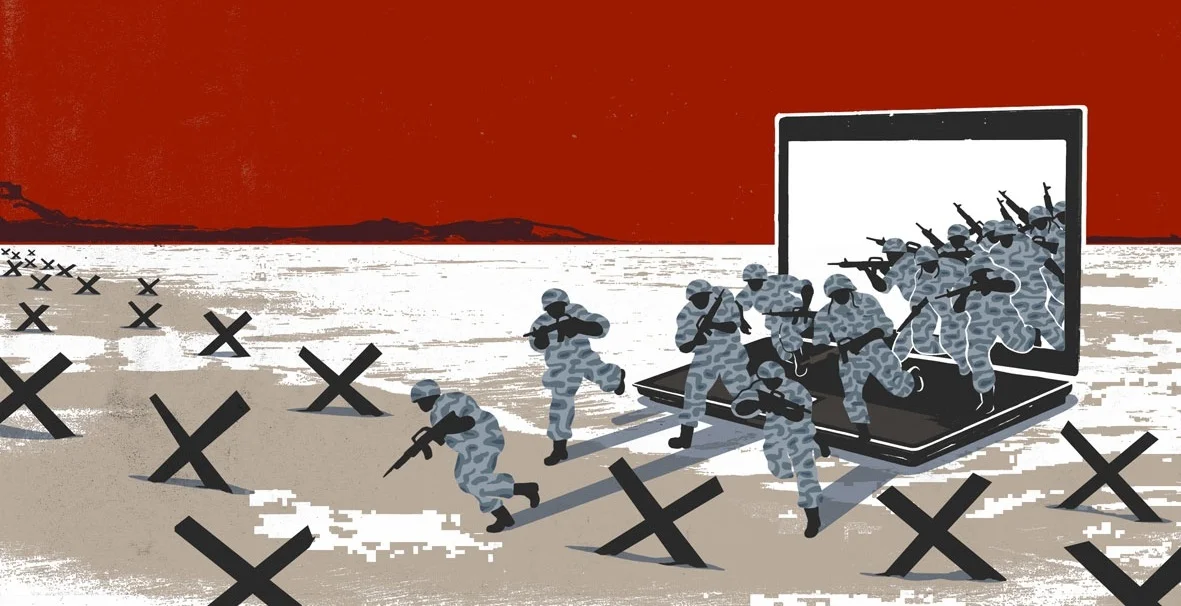
Waltzman used a variety of examples to demonstrate the range of diversity of Russian attacks using social media.
In turn, Watts showed how it extends this information: " The network is fairly systematic process introduced by the dissemination of information," like-minded supporters, aggregators (gray accounts) and hidden agents of influence (black accounts) are dividedmaterials of coordinated Russian propaganda with important nodes of the network on a one-to-one or one-to-many basis. ”This coordinated activity aims to convey, amplify and imprint influential content and its themes in the minds of a selected category of voters. distribute content that is attractive to the left or right of the political spectrum, as well as any anti-government and social topics of a problematic nature. Often this is done by profit hunters and political propagandists seeking to achieve high levels of views on a narrow range of topics intended for an even narrower target audience "(see also here and here).
All of this represents the realization of the basic idea that information is power and power. But for this they must believe it, recognize it, if not as true, then as possible. In the first case, the attacked model of the world will be destroyed, in the second, doubt will be introduced into it.
The recipient of the information is an important component, since the impact is on his cognitive system. The task of actions in all three spaces (physical, informational, virtual) is to influence the cognitive system of individual and mass consciousness. Our thinking is the main target of any information attack.
The military also emphasizes the cognitive aspect: “ For any practitioner of information warfare, the cognitive element is of the highest value. All activity is meaningless if it does not lead to a change in the understanding and perception of the selected audience . "And this is especially true for the British vision of information operations, since in them the goal is to change the behavior of the target.
We now turn to more specific points of communication affecting the cognitive realm. They can be embedded in the structure of the message itself as an additional component, or they can arise in transmission processes. You can, of course, imagine a situation where information acts as a trigger, triggering its destructive effect.
The first one who claims to be such a point of influence on thinking is the frame. Lakoff and Iyengar have written a lot about frames today and have produced famous books on these topics.
But other researchers also turned to frames as frame structures in the system of which news is fed. Framing works with parameters such as selection and selection. Back in the nineties, Entman defines a frame as follows: “The frame should select some aspects of perceived reality and make them more emphasized when conveying the text in such a way as to promote a specific understanding of the problem, cause-and-effect relationships, moral assessment and / or recommendations for the interpretation of the described phenomenon "[Entman R. Framing: Toward Clarification of a Fractured Paradigm // Journal of Communication. - 1993. - Vol. 43. - I. 4].
The frame, or frame, as we see, becomes an independent player in the processes of information transfer. It is not perceived as something separate from the news, but as news in itself. The average person cannot separate the frame from the news.
It follows that any kind of coverage cannot be neutral; it carries an echo of a model of the world, for example, of a journalist or publication. And in a fairly specific form. Thus, as it were, two functions are performed. On the one hand, no one can say that there was no information. On the other hand, the "weapon" passes along with the information. We look at additional information in this way, since the reader / viewer does not realize, except for obvious cases of juggling, that two messages are actually being entered into his head. He does not even think about it for the reason that each reader / viewer reads or watches the media that reflect his political beliefs, and rejects the media of opposing views as unreliable in advance, so all additional information seems to him quite natural,
This is very clearly seen in the classification of Iyengar news, which divided them into episodic and thematic [Iyengar S. Is Anyone Responsible ?: How Television Frames Political Issues. - Chicago, 1991]. The creation of thematic news requires more serious journalistic work, the involvement of experts, and the study of the context of the problem. Episodic news simply narrates what happened as a one-off episode. This is one of the reasons that television tends to provide us with mostly episodic news. For example, the news will report that a passer-by has been hit at an intersection. We will blame the individual for being careless. But if we are told at the same time that the crossing is not illuminated, that accidents often occur there, then in this case we will immediately blame the city authorities.
As Iyengar says in his interview: “ People are provided with episodic coverage on many issues - crime, terrorism, poverty, racial inequality. At the same time, there is a tendency to attribute responsibility for these problems to individuals, rather than institutions or broad social forces. Poverty, for example, is seen as a consequence of human laziness or lack of initiative; crime is a manifestation of antisocial personality characteristics. However, when people are confronted with thematic frames, their attribution of responsibility is likely to focus on social and political actors - politicians, politics, economics, and the like. In this sense, thematic framing helps people keep society accountable and vice versa."
And one more important explanation: “ Episodic frames focus attention on individuals, it is easier to see the reasons and interpretation in the person represented than in the context. In this regard, framing is analogical reasoning - news about this person, which means that this person has to do something about the problem in the news ."
You can think of a frame as a point of view on an event. We look from a certain position and see what is revealed to us from this very position. Without this or that point of view, it is difficult for us to understand the event, since we, as it were, do not have a key for understanding it. When we work with several points of view, we get thematic news, with one - episodic.
From Entman's point of view, frames can provide communicator, text, recipient and culture [Entman R. Framing: Toward Clarification of a Fractured Paradigm // Journal of Communication. - 1993. - Vol. 43. - I. 4]. Communicators have frames (schemas) that organize their presentation system. The text contains frames that are implemented in the form of keywords, stereotypes, sources of information; separate sentences that reinforce interpretations. The recipient's frames may not match the communicator and text frames. Cultural frames reflect the thinking of most people in a social group.
De Vries proposed his classification into two types of frame. Some frames are related to specific topics, so he suggested calling them problematic. Others are suitable for different problems, they are called general.
Frames, reflecting a specific model of the world, each time promote not only news, but also this model of the world. There is a well-known phenomenon, which Lakoff often wrote about: it is very difficult to replace the first frame with another one. His proposal is to build a different frame side by side, and not fight with the existing one. It is for this reason that politicians are “pushed” to come out with a commentary on the event before the opponent does, since the first interpretation is, as it were, automatically accepted by the mass consciousness. The alternative interpretation will require much more effort to propagate.
The next information management toolkit is the agenda. Our brains are able to pay attention to a small fraction of what is happening. Therefore, the authorities of any country set the task of getting their information into the conditional top five, to which the mass consciousness will pay attention. Therefore, the creation of such information, its dissemination and keeping in the field of attention is given special importance. One type of profession that does this is called a spin doctor. For example, he must prepare citizens for a future event, attract attention at the time of its flow / conduct and hold attention after its completion. Something like a story about the next Congress of the CPSU.
McCombs, in his study of the agenda, writes about a well-known goal: “The media should be successful not only in telling us what to think about, they should also be successful in telling us how to think about it ” [McCombs M ... A Look at Agenda-setting: past, present and future // Journalism Studies. - 2005. - Vol. 6, No. 4]. In principle, this is a deeper goal than the one that is achieved simply by informing, which is why we speak of this goal as an attack on thinking.
McCombs identifies two levels into which the information agenda is laid out. The first level is "objects", for example, problems, events, people, etc. Here the information agenda sets the importance of the objects. With its help, they are trying to make us pay attention to some events and not notice others.
The second level is the “characteristics” of the selected “objects”. The significance of the characteristics is set here. Some characteristics stick out, others are hushed up. In our head, an image of an object is constructed from those characteristics that have been named to us.
McCombs says the closeness and difference between framing and agenda is debatable because there is no one approach, but many definitions of framing.
In an interview, McCombs emphasizes that this approach began with the research of Walter Lippmann, although he never used such a term. McCombs says that at the heart of the agenda is the process of conveying meaning, importance. It is clear that in a huge sea of facts it is difficult for a person to understand, therefore mechanisms arise that accentuate certain aspects. By the way, they can be not only text; they can be experts who will say the right words; they can be political talk shows with the same function.
In this interview, McCombs praises Anderson C. The long tail. Why the Future of Business Is Selling Less of More. - New York, 2006] (see Wu's criticism of this approach, and also here). Anderson's idea was that you can sell a lot in niche markets, not just aim for global markets.
McCombs, applying this idea, considers, that is, small information markets (he does not mention this concept, but its essence is precisely this). People in such small associations of houses standing next to each other are interested in, for example, who can paint the house, whose car can be repaired. This is not journalism, but people need it. Robbery is also actively discussed. All this can be described as "neighbors' news". They can to some extent be integrated into journalism, although this is not yet the so-called citizen journalism.
Weaver emphasizes that there is a closeness between the second level of the agenda and framing [Weaver DA Thoughts on Agenda Setting, Framing, and Priming // Journal of communication. 2007. - Vol. 57. - I. 1]. They both focus on how problems or objects are reflected. Both focus on how we think about objects, not the objects themselves. However, framing additionally involves other cognitive issues: moral, cause-and-effect, lighting recommendations.
Now we can return to looking at the media as a kind of weapon, that is, situations when its informing and dangerous sides become one. It is this aspect that underlies Nissen's research, in the title of which the words “weaponization of social media” sound, conditionally they can be conveyed as “weaponization of social media” [Nissen TE The weaponization of social media and characteristics of contemporary conflicts. - Copenhagen, 2015].
Nissen starts with the idea that modern wars are not aimed at control of territory, as in the past, but at control of the population and political decision-making processes. It turns out that Donbass, and not Crimea, is just an example of modern warfare.
And one more coinciding characteristic - new wars are waged not for geopolitical interests and ideology, but for economic interests and identity. He echoes the words of Kaldor, a renowned expert on new wars, who said: “ The old wars were fought for geopolitical interests or for ideology (democracy or socialism). New wars are fought in the name of identity (ethnic, religious or tribal). Identity politics has a different logic than geopolitics or ideology. The aim is to gain access to the state for specific groups, which may be local or transnational, rather than pursuing a specific policy or program in the broad public interest. The growth of identity politics is associated with new communication technologies, with migration both from village to city and around the world, as well as with the erosion of many inclusive (often state-related) political ideologies such as socialism or postcolonial nationalism. Perhaps most importantly, identity politics is constructed through war." [Kaldor M. In defense of new war // Stability. International Journal of Security and Development. - 2013. - Vol. 2. - N 1 ].
Indeed, on the basis of the war, on the existence of an external enemy, the first stages of building a new Ukrainian identity easily took place. However, then this process was suspended. Moreover, either on purpose in order to deliberately stop it, or a struggle for language arises automatically.
The following observation looks like a warning against misconduct: “ The method of warfare consisted of capturing territory by military means. In new wars, battles are rare, and territories are captured by political means through population control. Population displacement is a typical technique: the forcible eviction of those with different identities or opinions. Violence is largely directed against civilians as a way to control territory, not against enemy forces."
I cannot refrain from making another very clearly formulated observation concerning the differences between two types of politics - ideological and identity: “ Identity politics concerns the right to power in the name of a specific group; ideological politics is about gaining power to carry out a specific ideological program. In the context of a new war, the typical example of access to the state is access to resources, not how to change state behavior . In such situations, the competition for power will be based on identity, and not on programmatic debates, even if the latter are more ideal than reality ”[Kaldor M. In defense of new war // Stability. International Journal of Security and Development. - 2013. - Vol. 2. - N 1].
If we add here one statement by Paskhaver about how the Ukrainian economy works, then much becomes more transparent than before: “Our capitalism is a network of monopolies in which the owners, in union and under the cover of bureaucracy and politicians, receive their monopoly rent. sharing with your "roof". 10-15 people at the top are the top of a gigantic corruption pyramid of hundreds of thousands of such monopoly entities. This is the social matrix, the fabric of our life. Everyone is woven into it, including ordinary citizens who are forced to exercise or defend their rights through corruption. This social matrix emerged and proved to be unusually stable, largely because it was fully compatible with the dominant strategy of survival."
Kaldor has clearly demonstrated what identity politics is used for. Back in 1999, she stated that identity politics is based on any specific identity: national, clan, religious, linguistic [Kaldor M. New and old wars. Organized violence in a global era. - Stanford, 1999]. Today, it has largely canceled the old understanding of war and international relations. Kaldor states: “The basic idea that social constructivist approaches have added is that how you frame objects determines how you find solutions in the social sciences. Much in these sciences concerns how you define human motivations, and this is impossible to establish objectively. All you can do is find an interpretation that allows you to act and express yourself in practice, to see how useful your interpretation has been."([Kaldor M. Old Wars, Cold Wars, New Wars, and the War on Terror // International Politics - 2005. - Vol. 42 - I. 4], see her other speeches here, here and here: Kaldor M. New vs. old wars. Second edition. - Cambridge, 2006). That is, we again come to the importance of how we interpret the situation. One interpretation generates one set of actions, another - another. True, the situation itself remains unchanged ...
Frames are one way or another view of the world. The one who controls them controls the world. Good or bad current president of this or that country, bad or good past president of this or that country - all these are interpretations. The media can strengthen a weak position by making it strong, or they can fundamentally weaken a dominant position. Kaldor has an interesting saying: " While old wars were associated with state building, new wars are occupied with the opposite, they tend to contribute to the dismantling of the state ." What tools are there for this? Words and pictures ...
Two more levels can be distinguished through which information becomes dangerous. This is a level above information, where it is only an integral part of a more complex structure, where the cognitive or semantic level can be attributed. And the second level is the actual communication processes, when circulation contributes inadvertently to the dissemination of dangerous information. At hearings in the Senate Intelligence Committee, for example, the following types of "unintentional" distributors were identified: WikiLeaks, Twitter, and simply journalists who, in pursuit of a sensation, begin to spread unverified information (see also about Twitter here). And although Facebook is not mentioned here, it can also serve as such a toolkit.
Information can be a structural part of ideological, scientific and other concepts that can work to destroy the structure of a particular national state (Bagdasaryan V. Cognitive weapon // VI Yakunin, VE Bagdasaryan, SS Sulakshin. New technologies of struggle with the Russian statehood . - M., 2013, see also our article). True, it should be admitted that this is more of an ideological defense than a cognitive one. An example of cognitive is the broader idea of cognitive security (see also here). Here, under this concept, influence and protection from other people's influence are summed up.
What is the future of this type of information-weapon-based approach? In 2013, the US military held a symposium on the use of neuroscience advances in spheres of influence and deterrence. Interestingly, even the well-known phenomenon of deterrence is well reinterpreted within the framework of new approaches.
Here are the thoughts of scientists in response to military challenges. Deterrence should be based on decision-makers, not states. In this case, one must focus on the leader's neurotic features. It turns out that 60% of the male population has the MAOA gene, which characterizes a predisposition to violence. The environment plays a special role in the activation of this gene.
And one more opinion, which differs from our usual understanding of someone else's ideology as evil: “ Ideology does not generate radicalization. Radicalization arises from anger at perceived resentment, shame at doing nothing about it, seeking status. This is why jihadist videos are so radicalizing, they provoke an emotional reaction. Chats and other forms of social media work like echo chambers, resulting in increased polarization. When like-minded people get together, they move to more radical positions."
The following can be noted as specific proposals. To create an effective message, you need to imagine who the audience will trust. For this reason, one should not start with creating a message, but with preparing the person or context within which the message will be credible.
The military and business are moving at a faster pace in the use of new methods. They have the best funding to deal with not only real, but also potential threats. For example, the Pentagon has developed instructions even in the event of a zombie attack (see here, here, here and here).
Information flows on the impact on the alien population are created by structures and disseminated by structures. It is difficult for an individual as a recipient to resist such industrial flows, since it is a game of professionals versus an amateur. Therefore, in response, structural units are also created, for example, one of the last was the corresponding Polish Center for Countering Russian Propaganda. However, one should recognize a certain discrepancy between the large financial costs of such structures and the not so impressive results of their work. This is due to the fact that readers read the information itself, and not counter-propaganda materials about it. On the other hand, not only informational, but also all other aspects of the struggle are hampered (see, for example,
And it must be completed by a reasonable observation of the creator of the theory of new wars, Kaldor: “ " Negotiation "belongs to the old way of thinking. There is a perception that new wars can be resolved through "negotiations" between the parties, but in new wars the parties often speak in extremist logic. They don't fight each other. They both kill civilians. And "negotiations" can legitimize both sides. We used to think that either you go to war and the other side surrenders, or you negotiate and reach an agreement. In reality, these steps are no longer the solution. First, you cannot "win" a new war. All you do if you go into a war is to make the war worse. This is what is happening in Afghanistan and Iraq. Second, the negotiations legitimize the rebel commanders. Therefore,". Let us emphasize that this is an interview of 2007, that is, it sounded long before Donbass.


