

Brother
Professional
- Messages
- 2,590
- Reaction score
- 544
- Points
- 113
In early July, the results of a study by Czech neurophysiologists were published, studying how being in a Nazi concentration camp as a child affected the brain structure of those who have survived to our time. They were able to establish that the former prisoners have less gray matter in some parts of the brain than people from the control group. The study authors also wondered what the psychological impact of the strongest stress experienced by a person in childhood could have on their own children and grandchildren. Meanwhile, a long stay on the brink of life and death affects not only neurophysiology and gives not only psychological consequences. Read more about this in our material.
Echoes of a Hungry Winter
In September 1944, the Allies were preparing a military operation "Market Garden" to liberate the Netherlands from German occupation. On the eve of the Dutch operation, the overwhelming majority of railway employees went on strike, which was to disrupt the supply of ammunition for the German army.However, the operation failed, and as punishment for the strike, the occupiers imposed a food embargo on the Netherlands, which led to mass starvation and death of about 18 thousand people.
Immediately after the end of the war (in May 1945), normal food supplies were resumed. Children born during and within a short time after the Dutch Hunger Winter many years later have become the focus of attention of scientists investigating the long-term effects of stress.
The cohort study included a total of 2,414 men and women born between late 1943 and early 1947. Surveys decades later showed that this group had a significantly increased risk of cardiovascular disease, type 2 diabetes, breast cancer, and schizophrenia. However, it is hardly surprising that stress on a woman during pregnancy can affect the health of her unborn child - it is not for nothing that doctors recommend that expectant mothers give up alcohol and smoking and be less nervous.
Interestingly, the children of the Dutch people studied were also affected by the effects of a hungry winter. They had a higher BMI compared to the control group (curiously, this effect only affected the children of the male participants, not the women).
As shown in a 2008 study, the Dutch in a cohort study 60 years after they experienced hunger while in the womb, had a decreased level of methylation of the insulin-like growth factor gene IGF2.
In fact, this means that the stress experienced by the parents caused changes in the DNA of their children at the level of epigenetic regulation. Perhaps it was through this mechanism that the echo of the hungry winter echoed in their grandchildren.
Epigenetics of trauma
In early July, the results of a study by Czech neurophysiologists were published, studying how being in a Nazi concentration camp as a child affected the brain structure of those who have survived to our time. They were able to establish that the former prisoners have less gray matter in some parts of the brain than people from the control group. The study authors also wondered what the psychological impact of the strongest stress experienced by a person in childhood could have on their own children and grandchildren. Meanwhile, a long stay on the brink of life and death affects not only neurophysiology and gives not only psychological consequences. Read more about this in our material.Echoes of a Hungry Winter
In September 1944, the Allies were preparing a military operation "Market Garden" to liberate the Netherlands from German occupation. On the eve of the Dutch operation, the overwhelming majority of railway employees went on strike, which was to disrupt the supply of ammunition for the German army.However, the operation failed, and as punishment for the strike, the occupiers imposed a food embargo on the Netherlands, which led to mass starvation and death of about 18 thousand people.
Immediately after the end of the war (in May 1945), normal food supplies were resumed. Children born during and within a short time after the Dutch Hunger Winter many years later have become the focus of attention of scientists investigating the long-term effects of stress.

Dutch food stamps.
Sander van der Molne
The cohort study included a total of 2,414 men and women born between late 1943 and early 1947. Surveys decades later showed that this group had a significantly increased risk of cardiovascular disease, type 2 diabetes, breast cancer, and schizophrenia. However, it is hardly surprising that stress on a woman during pregnancy can affect the health of her unborn child - it is not for nothing that doctors recommend that expectant mothers give up alcohol and smoking and be less nervous.
Interestingly, the children of the Dutch people studied were also affected by the effects of a hungry winter. They had a higher BMI compared to the control group (curiously, this effect only affected the children of the male participants, not the women).
As shown in a 2008 study, the Dutch in a cohort study 60 years after they experienced hunger while in the womb, had a decreased level of methylation of the insulin-like growth factor gene IGF2.
In fact, this means that the stress experienced by the parents caused changes in the DNA of their children at the level of epigenetic regulation. Perhaps it was through this mechanism that the echo of the hungry winter echoed in their grandchildren.
Epigenetics of trauma
Epigenetic regulation implies a change in gene expression by reversible chemical modification of nitrogenous bases in DNA or histone proteins associated with DNA. The main DNA modification is the attachment of the methyl residue -CH3 to cytosine, most often as part of special “islands” rich in cytosine-guanine pairs. Such islets are found in the regulatory regions of genes.Typically, an increase in methylation levels leads to a decrease in gene expression, and vice versa. Epigenetic marks are reversible, but are often associated with long-term changes in gene expression, which occurs, for example, during embryonic development and malignant cell transformation. Along with protein regulators, they determine which genes in a particular tissue should be “silent” and which ones should work.
The long-term health effects of people born during the blockade of Leningrad, which, unlike the relatively short-term famine in the Netherlands, lasted as long as 28 months and led to much larger human casualties, unfortunately, have not been studied in detail ...
Nevertheless, a small study, which involved 169 people born directly during the blockade, and 192 people born before it, did not find among them an increased predisposition to cardiovascular diseases and diabetes compared to people of the same age from other regions. ...
In an attempt to explain why famine among the Dutch led to more pronounced long-term consequences, the authors (from research centers in the UK) offer, among other things, the following hypothesis. The “Dutch winter” became a relatively short stressful situation against the background of a prosperous existence, which was immediately followed by the restoration of a normal diet. The siege of Leningrad lasted so long that for children born during this period, an extremely low amount of calories became a kind of norm. Moreover, according to the authors, Soviet women ate worse than Dutch women even before the war.
Domestic genetic studies also suggest the contribution of natural selection to this phenomenon: according to scientists from the Ott St. Petersburg Institute of Obstetrics and Gynecology, among the surviving blockades, gene variants associated with more efficient metabolism in general prevail.
Rachel Yehuda of the Department of Psychiatry at Mount Sinai Medical School in New York has spent many years studying the survivors of the Holocaust - the Nazi massacre of Jews in the occupied territories. In addition, her research team is studying their children born after the events mentioned.
Many of these people who have been persecuted and tortured suffer from Post Traumatic Stress Disorder (PTSD). According to American researchers, children of Holocaust victims also often experience PTSD-like symptoms and anxiety disorders.
Children of men who had been in Nazi concentration camps also had elevated blood cortisol levels (compared to Jewish children not affected by the Holocaust) and decreased sensitivity to glucocorticoid hormones, a symptom seen, in particular, in major depressive disorder.
Hypotheses explaining the transmission of physiological effects through the generation include both the role of social learning and the molecular mechanisms that influence gene expression.
Speaking about mental disorders, it is easiest to assume that people who have experienced a tragedy talk about it and broadcast a changed perception of the world to their children, which leads to mental disorders in the latter. In addition, people who are traumatized in this way can simply be poor parents and abuse children, both emotionally and physically.
Nevertheless, Euda's group did a small study that could clarify the molecular mechanisms of the observed neuroendocrine changes and provide an alternative explanation for "inherited trauma" using epigenetics.
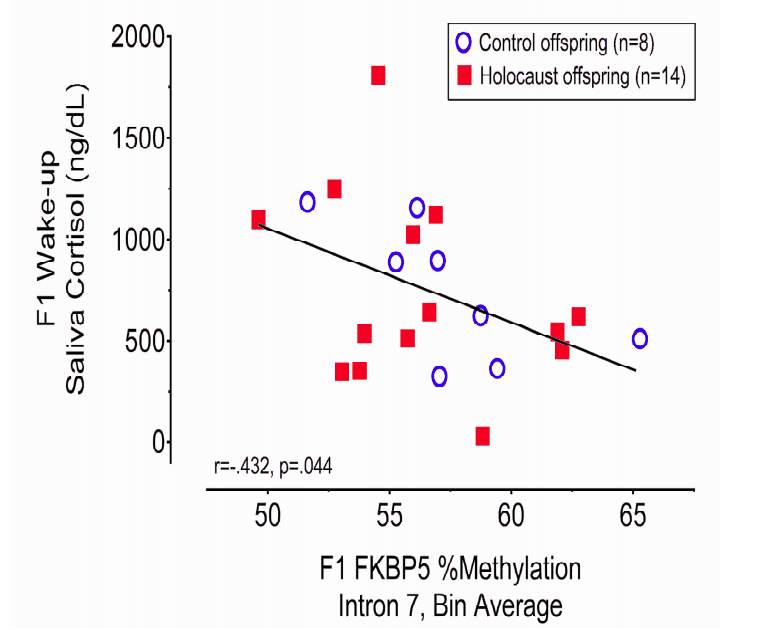
In the 2015, researchers from the Mount Sinai showed a small sample of participants through the study of blood tests that like the Holocaust, and their children have changed the methylation status of the site as part of a gene FKBP5.
This gene encodes a protein that interacts with the glucocorticoid receptor that can alter the sensitivity of tissues to corticosteroid hormones (including cortisol, one of the main stress hormones) that help adapt to stress and affect metabolism. Various variants of this gene are known to be associated with several mental disorders, including depression and PTSD.
At the same time, the changes in parents and children were multidirectional - in parents, the methylation level of the site was increased, and in children, it was decreased. At the same time, a low level of methylation correlated with a high level of cortisol in the blood.
Although this was not shown in the work, the authors suggested that hypermethylation of the FKBP5 site in the mother led to a chronic decrease in the level of corticosteroids in the blood, including during subsequent pregnancy, and this, in turn, led to a compensatory decrease in methylation and an increase in the expression of FKBP5 at the fetus.
As a result of the research, headlines such as "You can inherit psychological trauma from your ancestors" appeared in the press. The high-profile findings, in turn, drew the attention of critics to the work, pointing to the small sample size (about 20 people in each group), the weakness of the established correlations, and the limited experimentation.
Despite the rather shaky connections between PTSD and epigenetics, the findings from both of these stories show that hunger, war, and severe trauma can alter the way your genes work in ways that affect your offspring (children, and probably grandchildren) later. years after the events.
Sperm and the "RNA code"
The effect of unfavorable environmental conditions on epigenetic marks that persist for several generations has been well studied for plants, nematodes, and other model organisms. However, we are more interested in mammals, and here scientists have accumulated considerable experience in the course of experiments on rodents.In one of the studies, mice were separated from their mother at an early age, as a result of which they developed depressive behavior (such mice are less active and more often "fail" various behavioral tests, for example, one where they are thrown into water and forced to swim). Similar symptoms were observed in the sons of stressed males and in their grandchildren.
As the authors of the work showed, depressive behavior was associated with changes in methylation for a number of genes both in the sperm of mice and in the brain tissues of their offspring. In the case of mice, the implication is that social learning contributes less to the mental health of the offspring than in humans, although this factor cannot be ruled out either.
However, the experiment, during which the mice were trained to be afraid of a certain smell, made it possible to completely eliminate the factor of parental learning of children. Brian Dias and Kerry Ressler from Emory University School of Medicine in Atlanta (USA) forced mice to associate the smell of a certain substance (acetophenone) with mild electric shocks, causing the smell itself to trigger a fear response ... Moreover, the reaction to the smell persisted for two more generations of mice.
The authors of the work in Nature Neuroscience managed to clearly link this phenomenon with epigenetic inheritance. Acetophenone activates the well-known olfactory receptor, which is encoded by the Olfr151 gene. In trained mice, the developed reflex eventually led to a decrease in the level of methylation in this gene, which was preserved in their offspring.
As Diaz and Ressler wrote in the abstract of their article, "the inheritance of the traumatic experience of parents by offspring is a phenomenon that is often observed, but has no explanation." Indeed, the mechanisms of transmission of epigenetic marks are poorly studied, although in rodents, changes in methylation accompanied by inheritance of the trait were observed in the case of a variety of influences - hunger, fatty diet, toxins, and psychological stress.
In the case of inheritance of the trait by the first generation, the change in the physiology of the fetus can be explained by the altered physiology of the mother, as the authors of the work tried to do about methylation in the victims of the Holocaust. However, the transfer of a trait to the second generation (grandchildren) already requires the participation of germ cells.
The methylation status of genes in the egg and sperm cells can be changed, just like in all other cells of the body. However, until now, it was believed that after fertilization, the tags are mostly erased and re-attached as embryonic development.
Diaz and Ressler were able to clearly demonstrate the role of sperm in the process of epigenetic inheritance. They showed that artificial insemination of untrained females with the sperm of a trained male leads to the appearance of "trained" offspring. Thus, the inheritance of the trait occurred along the paternal line (we observed the same effect in the story of the descendants of hungry Dutchmen).
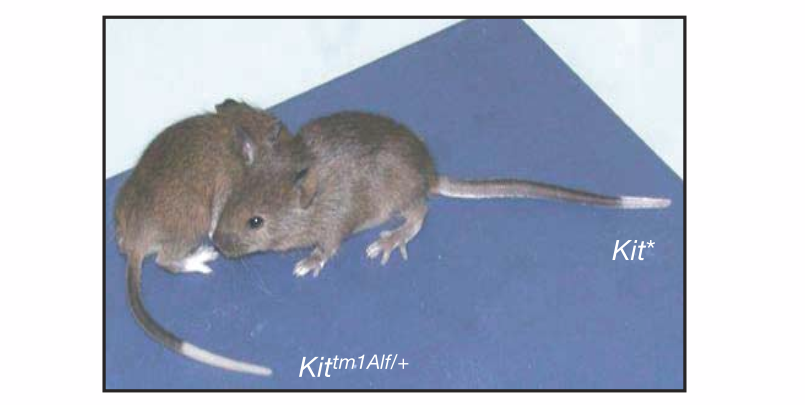
In recent years, the role of a new player in the field of epigenetics has been actively discussed - small non-coding RNA molecules that can interact with both DNA and other RNAs and affect gene expression. These can be specific microRNAs or even "trimming" of large RNAs that have other functions (transport, for example). Apparently, a large number of such molecules are transferred with the sperm, which are involved in epigenetic regulation. In one of the studies, the injection of an RNA fraction from the sperm of mice, which have a certain coat color due to an artificially introduced epigenetic modification, into an already fertilized zygote of "wild" mice led to the development of an inherited stained phenotype in the latter.
Semen contains so many different RNA molecules that some researchers have introduced the concept of "RNA code", by changing which it will be possible to predict the epigenetic effect on offspring.
A fairly large body of data obtained on animals suggests that epigenetic inheritance in humans most likely exists, but it will be very difficult to reliably distinguish its contribution from socio-cultural influence. However, there are still enough military conflicts and disasters on the planet that supply material for research. For example, a new project by researchers from the University of Zurich focuses on Pakistani children who have lost their parents. Scientists collect blood and saliva samples for DNA analysis of children, and hope that many years later they will be able to do the same for their children.
If one recognizes that a transferred tram can have long-term consequences affecting several generations, then the question arises as to whether and how they can be dealt with. As the panelists in the journal Neuropsychopharmacology note, there are nearly 500,000 combatants with signs of post-traumatic stress disorder living in the United States alone.
Thus, epigenetic inheritance potentially poses public health concerns and raises not only scientific but also ethical questions.

