

Brother
Professional
- Messages
- 2,590
- Reaction score
- 544
- Points
- 113
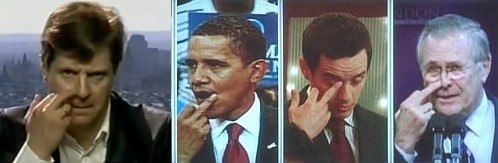
Just as there are slips of the tongue in speech, there are mistakes in body movements - these are emblems that give out information that a person is trying to hide.
It is possible to determine that the emblem is a mistake, and not made on purpose, by two points.
1. The action is performed not completely, but only in fragments.
You can shrug by raising both shoulders or turning your hands with your palms up, this can be done with facial expressions - raising the eyebrows while lowering the eyelids and giving the mouth a horseshoe shape - or a combination of all these actions, sometimes with the head tilted to the side.
When an emblem is an inadvertent leak of information, usually only one element is shown, and even that is incomplete .
You can raise only one shoulder, and besides, not very high, or protrude the lower lip; or just slightly turn your hands, palms up. An emblem with an exposed finger includes not only specially folded fingers, but also the throw of the hand itself forward and upward, and often several times. When the emblem with the exposed finger was not displayed intentionally, but only betrayed suppressed rage, the movement was not fully manifested, only the fingers worked.
2. An indication that the emblem is a "reservation" rather than an intentional action is that it is not performed in the usual position.
Most of the emblems are displayed directly in front of you, between the waist and the neck area. It is impossible not to notice the emblem displayed in the usual position. With "reservations", the emblem is never performed in the usual position. If the emblem was executed in its entirety, and not in fragments, the liar would understand what was happening and would correct it.
Of course, these moments (fragmentation and execution outside the usual position) make it difficult for others to notice the emblem. These treacherous emblems can be displayed over and over again, but usually neither the liar himself nor his victim will notice them.
Although not every liar exhibits emblematic slips, when they do occur, it is quite a sure sign that emblematic slips can be trusted.
They are real signs of unwittingly escaping information.
Some people always speak evasively, but few make emblematic slips on a regular basis. Speech mistakes can indicate stress, and stress is not necessarily associated with lying. Emblems, on the other hand, have very specific meanings (in this they are like words), so emblematic clauses are usually easier to interpret. If a person slips a message like “I had you,” or “I'm furious,” or “I didn't do it on purpose,” or “over there” - any of which can be portrayed by means of an emblem - there are no particular problems with interpretation.
To learn more about the meaning of gestures and gestures as such, as well as about which gestures are most effective in a given situation, what facial expressions appear on a person's face depending on the experiences he experiences, you can read Paul Ekman's book “The Psychology of Lies. Fool me if you can."

