

Tomcat
Professional
- Messages
- 2,695
- Reaction score
- 1,072
- Points
- 113
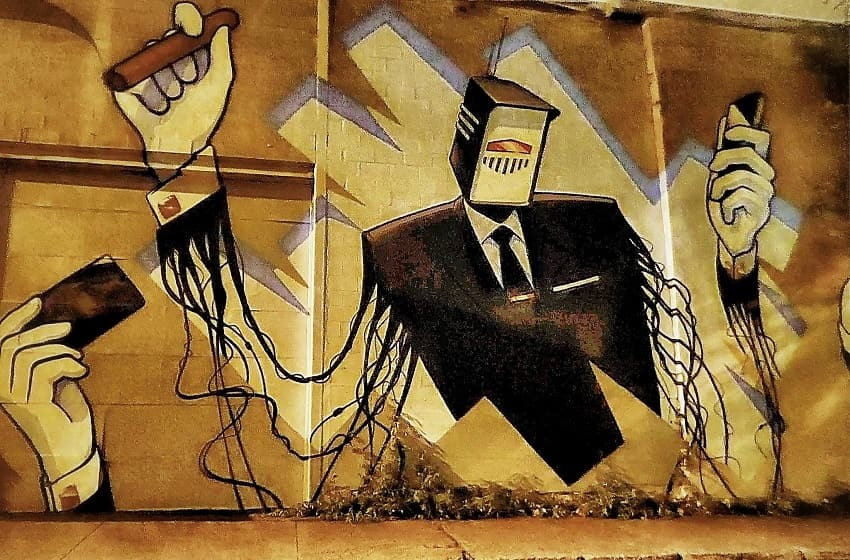
The German philosopher and sociologist Herbert Marcuse called the total programming of society for false values that provide them with an excess of material wealth "neototalitarianism." He believed that the negative side of technological progress, democracy and capitalism was the loss of individual thinking and the ability of a person to live by their own rules. We figure out what processes taking place in society led Marcuse and other philosophers to such conclusions, why, according to the thinker, a spiritual crisis has become the reverse side of material well-being, and how a “one-dimensional man” appeared on the stage of history, who is afraid to be alone, because he practically does not have anything of his own, if we take away from him both informational and material consumption.
Technological progress, which overnight turned the lives of millions of people in the late 19th - early 20th centuries, for many years inspired positive hope for the liberation of the inhabitants of the planet from class dependence and direct slavery. With the development of technology, the world has partially managed to get rid of child labor, violation of the labor rights of the individual and the need to work for a large part of the population almost round the clock just in order not to die of hunger ...
But the rapid development of production made it possible to get rid of not only the tragic realities of the past. In the shortest possible time, the whole world became "universal": thousands of identical things appeared on store shelves, filling tens of thousands of monotonous houses. With the advent of television and radio, millions of people listened to identical information and involuntarily memorized repetitive messages. For the first time in the history of mankind, the world is faced with the threat of the loss of individualism.
It is interesting that the situation that arose did not raise questions for a long time, because technological progress saved people from poverty and the need to survive, simplified communications and united billions of individuals through the media. Only a few decades later, leading philosophers, psychologists, sociologists, among whom were Z. Freud, E. Fromm and G. Marcuse, sounded the alarm.
Practice has shown that the exhausted person happily agreed to exchange the need for independent thinking for material wealth. This is confirmed by the results of political propaganda in any state. It is known that the voter is ready to vote for the leader who promises him a solution to pressing everyday problems. At the same time, with a high probability, he turns a blind eye to the political atrocities perpetrated by the same leader. This is how propaganda operated during Nazi Germany, for example. The rule of “a radio in every home” made the Germans a slave mass who believed that the government was concerned about their welfare.
According to the German philosopher, sociologist and culturologist Herbert Marcuse, in such situations, due to the fault of dependent media, there is not a choice, but only an illusion of choice. The widespread use of television, radio, and today the Internet leads to the fact that every day a frantic stream of repetitive information is poured into a person's head. It is thanks to repetitions that a person appears to be programmed: he so often hears this or that message, whether it be advertising goods or propaganda of the actions of a political party, that he begins to consider his actions an act of goodwill.
In addition, in the reality of such a one-dimensionality, in which the thinking of the individual is relegated to the background, the cult of consumption, which is gaining momentum every year, plays an important role. Major philosophers never tire of saying that false needs imposed by the media and advertising overshadow the personality and force it to act irrationally. It is no coincidence that so many people work for income, which they are going to spend on unnecessary things stored on the shelves of closets. At the same time, the cult of consumption has reached such a degree that the average buyer often simply cannot answer why he bought this or that thing. According to the UN, a third of the food is wasted in the world today.
"Happy consciousness is the belief that the real is rational, that the system embodies good."
The formally satisfied rights and freedoms of the individual have led to the fact that the owners of the "happy consciousness" are ready to agree with the crimes of society, regardless of their severity. Marcuse notes that this fact speaks of the decline of personal autonomy and understanding of what is happening.
Thus, "one-dimensional people" are completely unaware that they are far from democratic reality. The philosopher called the total programming of society for false values that provide them with an excess of material wealth "neototalitarianism."
Moreover, Marcuse argues that the principles of the new reality managed to take on recognizable features not only in the visual similarity of things and objects that filled almost every apartment, not only in the predictable behavior of people, but also in human language. Like George Orwell, the sociologist that mutually exclusive concepts, abbreviations and an all-consuming tautology came to modern language, which led to the impossibility of finding the truth and the absolute confusion of mass consciousness and the substitution of concepts.
“They believe that they are dying for the Class and dying for the party leaders. They believe that they are dying for the Fatherland and dying for the Industrialists. They believe that they die for the freedom of the Personality and die for the Freedom of dividends. They believe that they are dying for the Proletariat and dying for its Bureaucracy. They believe that they die by order of the State, and die for the money that the State owns. "
Of course, it cannot be argued that absolutely all members of society agree with life in a one-dimensional reality. But critics point out that getting out of it is almost impossible. In the information age, this is due to the fact that a person is not able to cope with the amount and quality of information poured onto him. It is interesting that the more facts from the media a person learns in a day, the more empty he feels. It is not uncommon for journalists who work in news departments to complain about their inner emptiness. Many of them claim that they are forced to work with an avalanche of information that does not concern them, exhausting and quickly forgotten, leaving no time and energy to think about their own lives.
In the event that a person decides to think independently and refuses to be a participant in global consumption, he is faced with the problem of finding information. Going into a search engine, he understands that for any request he receives thousands of claims to the truth and at the same time opposite opinions. Most people, however, completely abandon the need to seek the truth and find it convenient to trust the opinion of the federal media, advertising and mass culture.
Speaking about one-dimensionality, political scientist S. Kurginyan notes that the modern world political system tacitly prohibits individuals from living by their own rules. After all, as long as Orwell's "stockyard" listens to the voice from the outside, you can convince him that, solving private interests, in fact, he allegedly satisfies his own. Kurginyan put it this way about trying to understand what is happening:
“So many pseudo-means should be thrown onto the market that you are entangled in them, and your brains should not have criteria by which you select the genuine from the inauthentic, the necessary from the unnecessary. You should be deprived of the tools of choice, you should not have teachers, all teachers should be compromised, and the difference between a teacher and a charlatan is completely erased. "
At the same time, opinion polls show that, despite the external level of happiness, more and more people actually feel lost in the sea of information, empty and unhappy. The statistics of suicides and violence suggests that a “happy mind” does not save an individual from total dissatisfaction. The information garbage that has accumulated in the head for years leads to the fact that it becomes scary for a person to be alone with himself, because he practically does not have anything of his own. This is because in a one-dimensional reality, a person associates himself more with his things than with his thoughts.
In the book To Have or To Be, E. Fromm notes:
"If I am what I have, and if what I have is lost, then who am I?"
Kurginyan says that in a world of abundance, many feel dissatisfied, but not everyone is ready to go for the feat of self-discovery.
“Everything genuine is difficult, slow, requires you entirely, painfully. And they offer you something simple ... People feel the incompleteness of life, they want to join themselves. They feel that the means for this are somewhere nearby, but then they need to be shown false means. Those who want will seize on false means, and the rest must stop wanting. "
It is noteworthy that the current opposition cannot influence the situation, since it plays on the same one-dimensional field. What is to be done in the world of rose-colored glasses and a consumer cult that makes people ignore global problems and the loss of individuality?
Marcuse believed that the only way out of the prevailing reality could be the "Great refusal" from the consumption of things and imposed information.
"The shutdown of television and similar media could thus give an impetus to the beginning of what the fundamental contradictions of capitalism could not lead to - the complete destruction of the system."
It is clear that such a conclusion is utopian and will never become reality. But it is also clear that today a way out of one-dimensionality is still possible, but it concerns a very small part of people and does not change the system as a whole.
Fortunately, the very Internet and the very protected rights and freedoms of the individual allow one to voluntarily abandon a number of norms accepted in society, such as uncontrolled consumption or chewing propaganda. Obviously, the only way out of the “one-dimensional person” cage is self-development, conscious comparison of several sources of information, development of the ability to think, rejection of direct faith in the media. And while historical conditions allow using a wide variety of information and do not create lists of forbidden literature, the way out of one-dimensionality entirely depends on the desire and persistence of a particular individual.


