

Tomcat
Professional
- Messages
- 2,695
- Reaction score
- 1,072
- Points
- 113
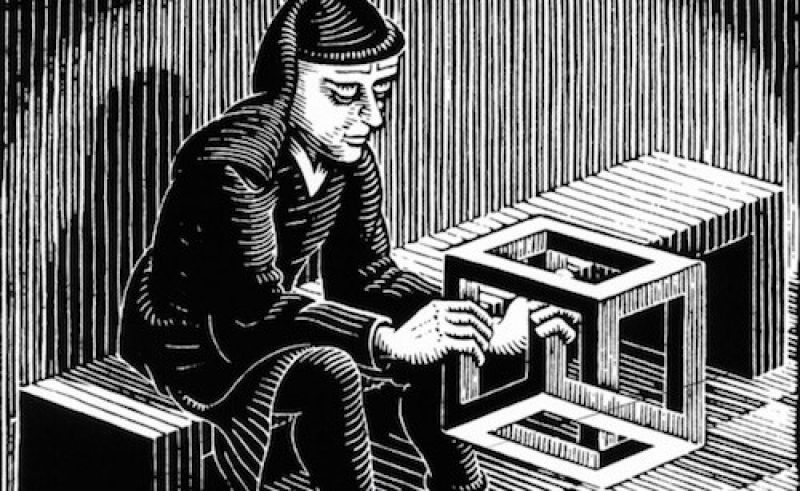
Milton Erickson - according to his students - sometimes used in his work with Clients tasks containing an obvious contradiction, a paradox:
EXAMPLE. “Once the parents of a child who bite his nails all the time approached him and asked him to help get rid of this habit. Erickson agreed. He told the boy to bite the nail on only one finger on each hand, without touching the rest, and did it right in front of his parents' eyes for twenty minutes a day. As a result, the child could no longer perceive this action as a protest, because it became a daily duty. All pleasure from the process has disappeared. Gradually the boy began to bite his nails less and less until he stopped completely."
EXAMPLE. “More often than not, his Zen interventions were the“ too smart ”intellectuals whom he tried to knock out of their overly rational mind in this way. For example, Jay Haley describes in his book "About Milton Erickson" (M. "Class", 1998) a case when Erickson gave an absurd task to a too rational patient. He instructed him to drive 7.3 miles in the desert, stop, get out of the car, and understand why he was there. What is not a Daen koan!
Another technique for Erickson's use of the paradox is to prescribe to keep the symptom that the client wants to get rid of. Moreover, the client was instructed to experience this symptom in a strictly defined place and at a strictly allotted time. Now the client is trapped! Acting in this way, the patient understood that the symptom is not a spontaneous manifestation of his psyche, and he can control it. And what is controllable is no longer a symptom. Or more.
The client is given two messages at the same time, directly opposite. He is faced with a seemingly insoluble dilemma. His rational mind begins to "wedge", it overheats and is about to melt, and smoke will fall from his ears. The unconscious is feverishly looking through the mass of probabilities and possible solutions. There is a sharp tilt of the psyche "to the right side": the logic and rationalism of the one-dimensional and linear left hemisphere of the brain slows down, access to creativity and spontaneity of the right hemisphere is opened. There is a chance to become enlightened!
Behaviorists use the "flood" technique. A client with a phobia is thrown into a situation where his phobia will be most intense. This treatment is of the wedge-wedge-knock-out type. Behaviorists proceed from the assumption that when the client experiences his fear to the maximum extent, it will decrease and then disappear altogether. Well, maybe so, if the client does not die of fear before that time.
Viktor Frankl, created the technique of "paradoxical intention". He proceeded from the assumption that the neurotic, fearing something, falls into a vicious circle. A symptom gives rise to a phobic reaction, it aggravates the symptom, a symptom aggravates the phobia, etc. Fear generates exactly what a person fears.
If a person is afraid of something, constantly thinking about how to avoid it, he will get exactly what he seeks to avoid, becoming more and more entangled in the networks of neurosis. The same is true for obsessive thoughts or actions. The more a person concentrates on how to get rid of them, the stronger they will become. A well-known business! Try not to think about the white monkey.
The goal of the paradoxical intent technique is to break this vicious circle. The client is given the task to desire what he fears, to strive for it. Fear is replaced by paradoxical desire. The purpose of this simple technique is to distance the patient from his neurosis. A great helper in this matter is humor. The client is not convinced by making rational arguments in favor of the absurdity of his fears or obsessive actions; on the contrary, they tend to exaggerate.
The result is a decrease or disappearance of the symptom. Moreover, a psychotherapist using this technique should not at all worry about the etiology (origin) of symptoms. Frankl claims that it is especially effective in the treatment of phobias, obsessions, sleep disorders."


